
Editor’s Note: Over the past year, Fresh Energy has partnered with Change Narrative founder Jothsna Harris to help our staff explore and articulate their personal climate stories through guided workshops and reflective writing exercises. The following post is the fourth in a series in which Fresh Energy staff share their individual climate stories, providing an intimate, personal look into our staff’s diverse experiences, passions, and connections to place that shape our dedication to building a carbon-free economy that works for all Minnesotans. Climate stories are representative of the staff member, not necessarily the organization. This story was written in December 2024. –Isak Kvam
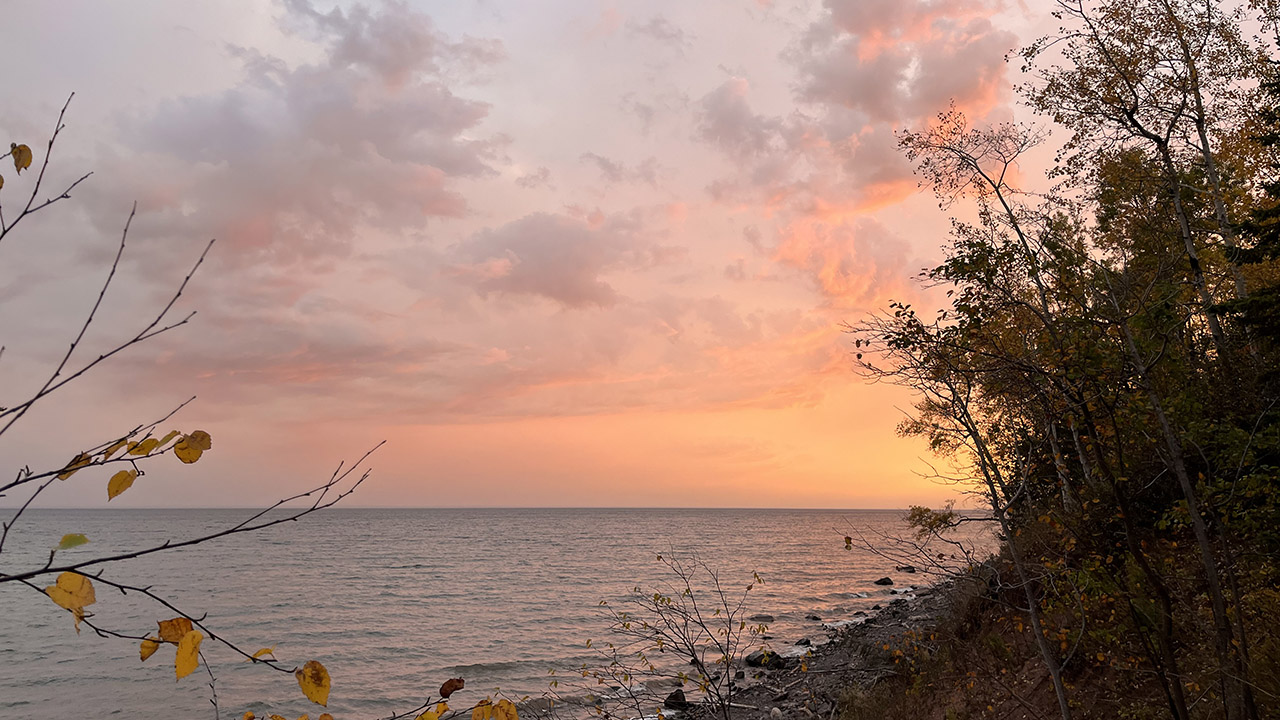
It begins in Minnesota, although it doesn’t end here. But it begins in this land of sky-tinted waters, as the translation goes. Significant, that this is what Minnesota means, since the aspect I most associate with home is the sky, in all seasons: the gentle brightness of the spring; the expansive azure that marks summer, with perfectly white clouds sailing across it, so big and blue it feels like you could look up and fall in. The clarity and quality of its honey autumn sunlight; the crispness of its obsidian winter nights when the stars’ edges are cut like diamonds.
These skies have inspired my one and only tattoo, a reminder of home sewn in ink while I explored other parts of the country. They also beckoned me back, ten years after I had first wandered away. I came anticipating and already thrilled by the icy winters ahead that would bring me those bright sapphire tones above, only possible in the subfreezing temperatures that so often adorn January.
But my first winter back in 2020, we broke a record for gloomiest January, with a 10-day streak of no sun. That record held until last year, when January 2024 became the least brilliant January on record. Something had changed.
And it wasn’t just winters. Summer skies were hazier too. Despite me having left California and its choking wildfires, blazes north of us in Canada were increasingly common, ushering in smoky skies and apocalyptic haze that’s cloaked almost every summer since I’ve been back.
Coming back to Minnesota and realizing the future is here, that we live in a climate changed reality where the Minnesota I grew up in for 18 years is not the Minnesota I returned to, is something I’m still moving through. Writing has helped, as well as remembering the resilience and adaptability of people and previous generations. Change is hard but it is inevitable, even as we try to make it less so in our work.
But learning how to embrace new skies is surmountable compared to what’s happening beyond Minnesota.
In writing this, it was hard to reflect on the grief inherent in climate work without linking it to the grief I and many others feel when seeing what’s happening in the Middle East, in the West Bank and Lebanon, and especially in Gaza. To know that the clear blue skies I long for are things that the people in those places long for too, for very different reasons. Their skies are overwhelmed with smoke and dust from Western-made weapons, from destruction, from war – things that are antithetical to achieving a just and equitable clean energy transition, let alone addressing climate change. The outrageous amount of money poured into this annihilation from our very own taxes is antithetical to addressing climate change.
Seeing international bodies being demeaned and dismissed, seeing healthcare workers demonized and health infrastructure demolished, hearing the silence from those in power in calling what we’re all seeing what it is, a genocide, is antithetical to addressing climate change. Addressing climate change in the ways we want to, swiftly and equitably, relies on international cooperation, free speech and protected journalism, an acceptance of facts, a functioning healthcare system, and a shared and clear moral compass to guide us through the false solutions and the fear of radical transformation that we have and will continue to face.
The climate work we do in the U.S. is inextricably linked to and undercut by what we are enabling in Gaza. It’s undercut whenever our country’s political power and resources are going towards stamping down and destroying rather than calling in and building. Our dreams of a new world where people are safe, healthy, and cared for in an economy that runs on clean energy requires us to see this connection.
Our commitment to courage and responsibility requires us to see this connection.
No just transition is remotely possible if we cannot see, do not really understand, this connection.
I have no clear ending, so I will simply share something my Sikh faith has taught and imbued in me and my climate work: courage is the essence of a life well lived, and we all have the responsibility to do what’s in our power to make things right for the most vulnerable amongst us.