
The 31st Conference of the Parties (COP30) to the United Nations Framework Convention on Climate Change is underway in Antalya, Türkiye. J. Drake Hamilton, managing director, science policy at Fresh Energy, is attending the conference in person and is updating this blog daily. Follow along and register to attend her debrief webinar on November 23!
November 19 | Only one whole day left for COP31
COP31 will close when the legal “text” meets consensus. I will be able to describe the full legal text during my Monday, November 23 webinar, which you can sign up for here.
First, we should be clear: this summit is not seen as a banner year for the negotiations, largely because it falls between two “global stocktakes” of progress. Under the Paris Agreement, there is a periodic review that evaluates how well countries are meeting global climate goals every five years. Second, the global stocktake spots delivery gaps where countries fall short. Third, countries with gaps are asked to raise ambitions in the Nationally Determined Contributions (NDCs). The next one is due in 2028.
However, there must be a final COP31 text containing all items agreed upon by consensus. It is due midnight in Antalya on November 20, 2026.
At COP31, negotiators from nearly 200 countries started working on writing an “informal text” on Day 1. Think of this as an early working draft which is not yet expressed in formal legal language.
Even before this, negotiators must agree which issues are on the summit’s agenda. COP31’s talks come with a twist: Turkey holds the presidency and is hosting COP31, but Australia is jointly running the COP as “president of negotiations.”
The final text could include recognition that warming is set to overshoot the 1.5° C target.
The approved text could also include potential solutions, such as the Turkish presidency’s “electrification” target: 35% of global final energy to come from electricity by 2035.
Over the past 10 days, negotiators have produced “clean” texts that contain no areas of disagreement among the parties. Some of these clean drafts can be converted into “draft decisions” that are ready for formal adoption at the closing plenary of the climate summit.
Some topics get known as “red” topics, when negotiators have not yet managed to put anything down on paper, possibly because parties have fundamentally different views on how to proceed.
I have been closely watching several text trackers to see how they’re doing. At the closing plenary tomorrow, the COP president must gavel through the text, signifying its formal adoption by parties as a legal agreement and outcome of the COP31 summit.
Negotiators need to reach consensus on more than 100 separate agreements.
Diplomats from nearly 200 delegations are hashing out behind closed doors in the Blue Zone, haggling over each word in every line of the text.
Tune in on Monday, November 23 for my assessment of the COP31 text.
November 18 | Governor Walz brings Minnesota’s climate leadership to global stage at the United Nations Climate Change Conference
Governor Walz brought Minnesota’s record of climate action to the global stage at the 2026 United Nations Climate Change Conference (COP31) in Turkey, highlighting how state leadership can cut emissions, protect natural resources, strengthen communities and create economic opportunity. At COP31, Governor Walz joined governors, mayors, and international leaders to discuss how states and cities are advancing climate solutions, building partnerships, and delivering tangible benefits for residents.
“Climate action is about protecting the things Minnesotans cherish: clean air and water, healthy communities, and the farms, forests, and outdoor spaces that sustain us,” said Governor Walz. “Minnesota has paired ambitious goals with real investments and strong environmental protections. We’re showing that climate leadership at the state level creates good jobs, strengthens our economy, and makes life better for people across the state.”
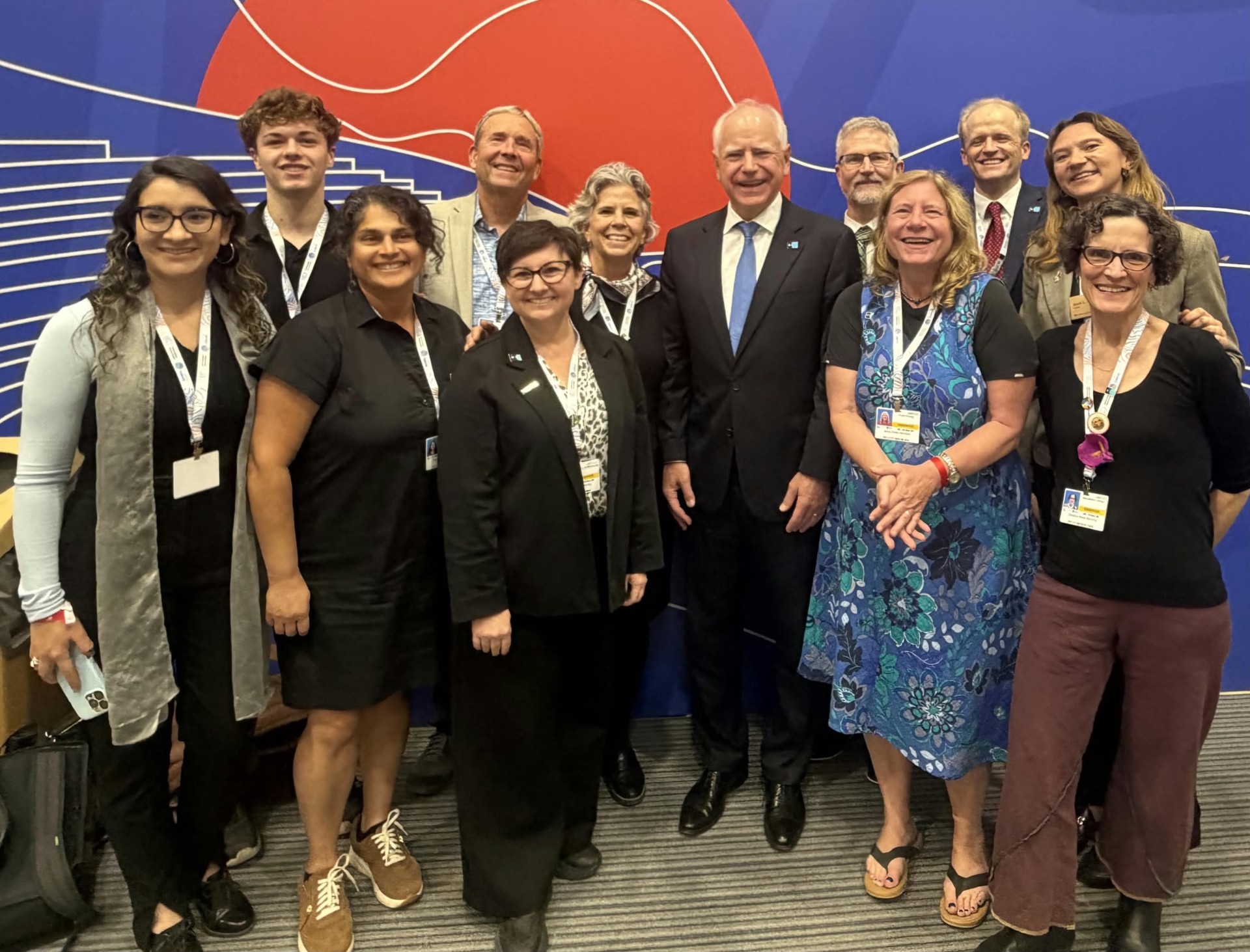
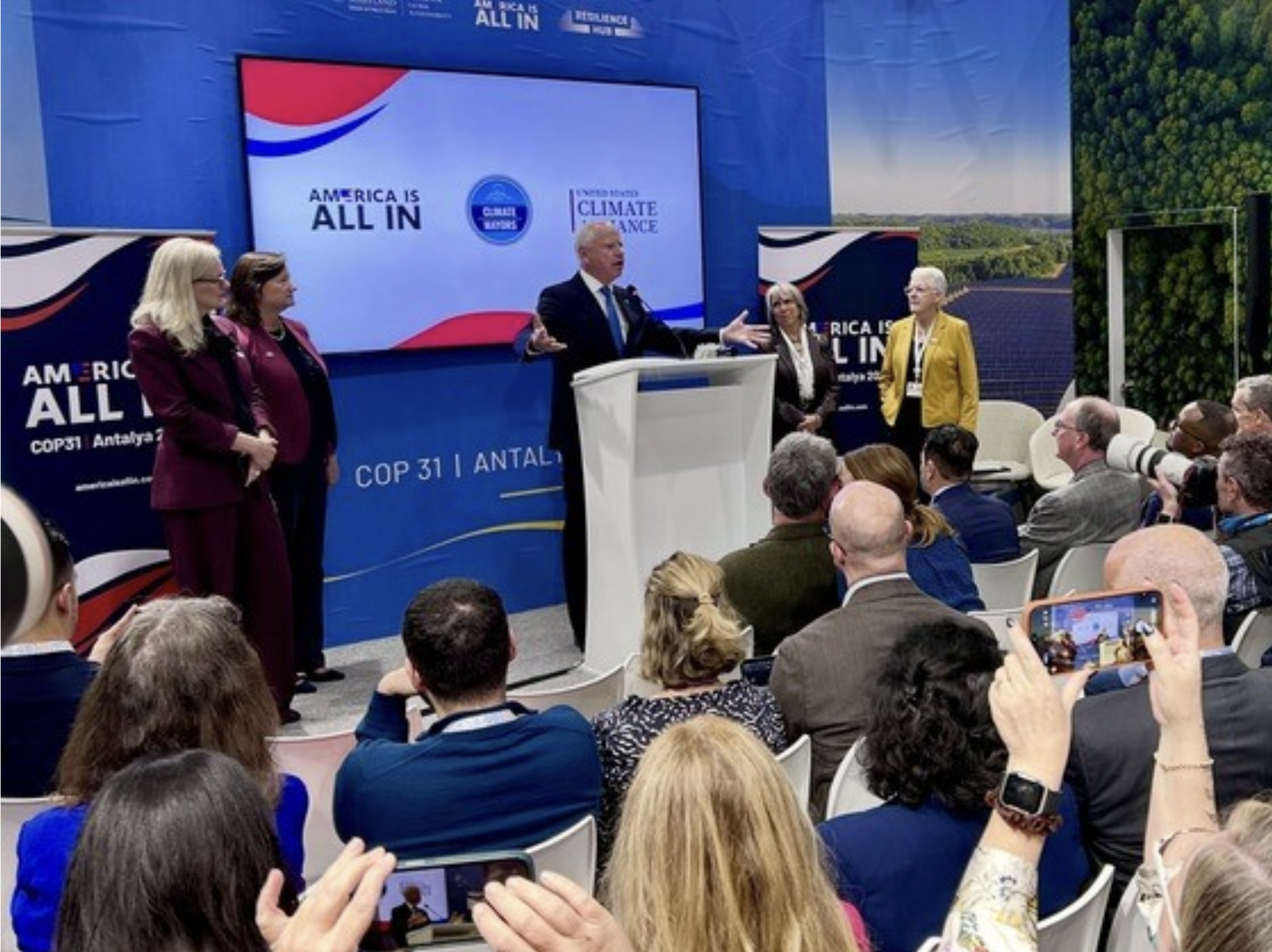
I was honored to be in the room with Governor Walz at his four scheduled events on the COP31 global stage. He addressed an always-overflowing audience at a one-hour November 12 press conference as a speaker at America Is All In’s main program; “Local Action, Global Partnerships” on November 12; at a guest appearance at noon on November 13 to a packed crowd of civilians and members of the global media at the All In Pavilion’s “Implementing America’s Energy Transition;” and finally on November 13 speaking to yet another throng of people from across the world at “Undaunted: Governors Sustaining U.S. Climate Progress with Bold State-Led Action.”
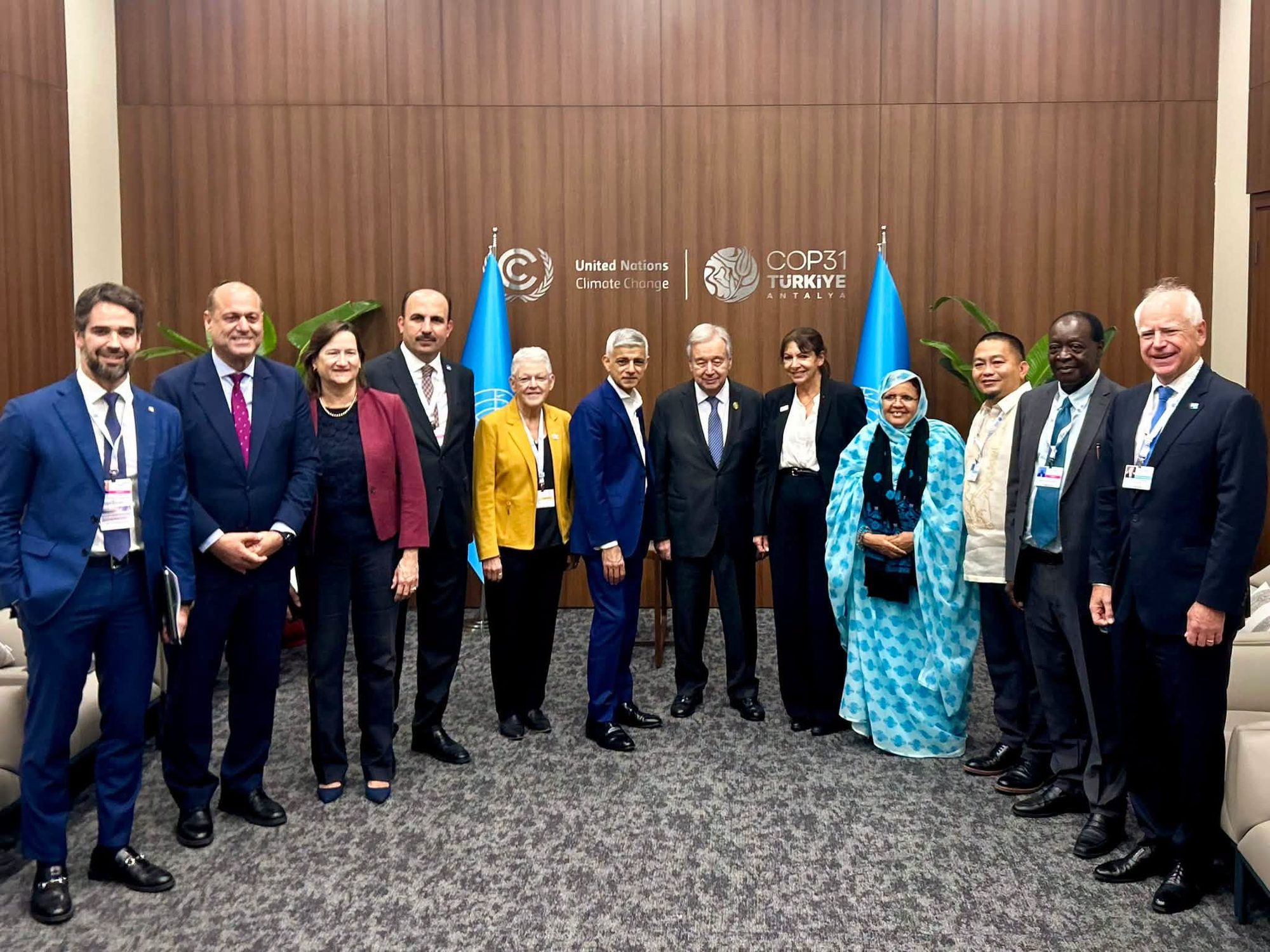
During the conference, Governor Walz spoke on behalf of the bipartisan U.S. Climate Alliance regarding the role of governors in advancing climate action. Governor Walz joined discussions with international leaders on scaling practical solutions. He met with the United Nations leadership, António Guterres, U.N. Secretary-General. Governor Walz also met with climate representatives from France, the Netherlands, and Wales to discuss collaboration and Minnesota’s clean energy work.
Since taking office, Governor Walz has signed more than 40 climate laws and directed more than $1 billion in state funding toward climate change mitigation and adaptation. His administration established a Climate Change Subcabinet and appointed a Governor’s Advisory Council on Climate Change (including Fresh Energy’s J. Drake Hamilton!).
The Subcabinet and Advisory Council updated in February 2026 Minnesota’s Climate Action Framework with input from thousands of Minnesotans to guide the state’s work to reduce climate pollution and prepare communities for climate impacts. Governor Tim Walz brought a printed copy of the MN Climate Action Framework to Turkey and held it high above his head from the global stage.
A cornerstone of that work is Minnesota’s 100% carbon-free electricity law, which requires utilities to provide carbon-free power by 2040, with a 55% renewable electricity benchmark by 2035. More than half of the state’s electricity comes from carbon-free sources. The administration also streamlined clean-energy permitting and invested more than $100 million in local climate resilience and water infrastructure, established a $105 million climate innovation finance authority, and updated building codes to reduce energy use in new buildings.
Governor Walz said every time from the global stage of COP31: Minnesota has never stopped, and “we have not slowed down one bit” on bold climate and clean energy action. Minnesota never stopped talking about climate change, extreme heat and wildfires, and what we must do to mitigate and adapt. Minnesota has continued to make great progress, and the state is currently on a trajectory to meet our 100% carbon-free electricity law by 2037.
November 17 | Update — How many people are attending COP31?
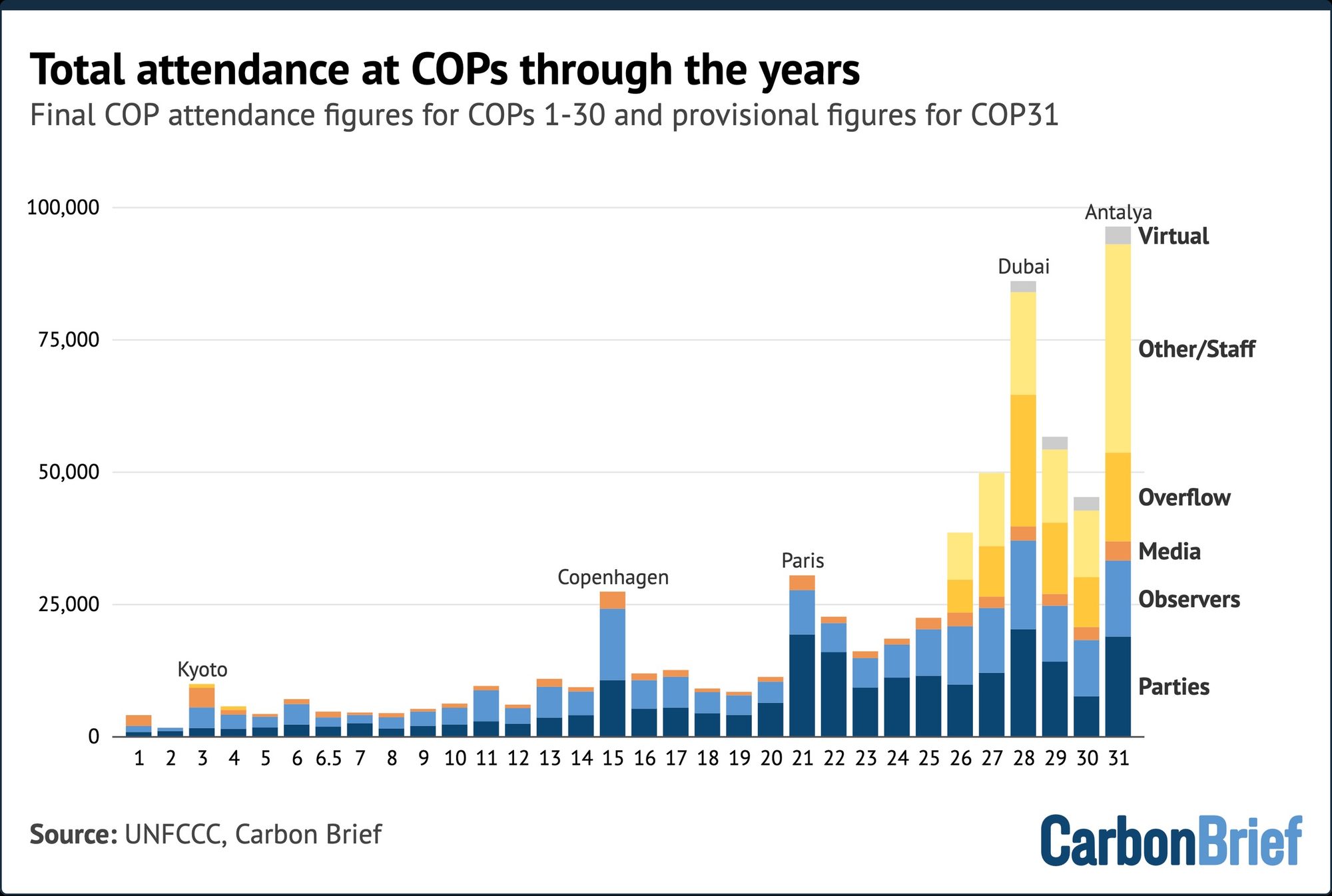
With over 92,000 participants registered for COP31, it may be the largest COP in history. It is likely that COP31 will top Dubai’s COP28, which was attended by over 80,000 people.
The UNFCCC releases the final figures after the climate summit has ended. The true numbers are based on the number of participants who collect a physical badge at the venue.
The largest official delegation in Antalya is the conference’s host, Turkey, with 2,950 people. Second largest is Brazil (1,994). Third is Nigeria (1,506), followed by China (1,021), Indonesia (978), and sixth Australia (835).
Myanmar did not send a delegation, and Israel was banned from attending. The U.S. did not send a delegation to COP30 in 2025 and again has not sent a delegation to COP31 this year.
November 17 | In Conversation: U.S. federal climate action
On November 13, Senator Sheldon Whitehouse (D-Rhode Island) sat down in conversation with Gina McCarthy, Chair of America Is All In. I wanted to hear this very knowledgeable leader provide ideas about work needed in the remaining 119th Congress and what the actions the new 120th Congress should prioritize.
I was not alone in the audience! The All In Pavilion was again crowded with a big international audience to hear from this esteemed senator.
Senator Whitehouse has been to every COP I have (plus many more).
He has always been blunt, and he speaks as perhaps the most knowledgeable leader on climate science.
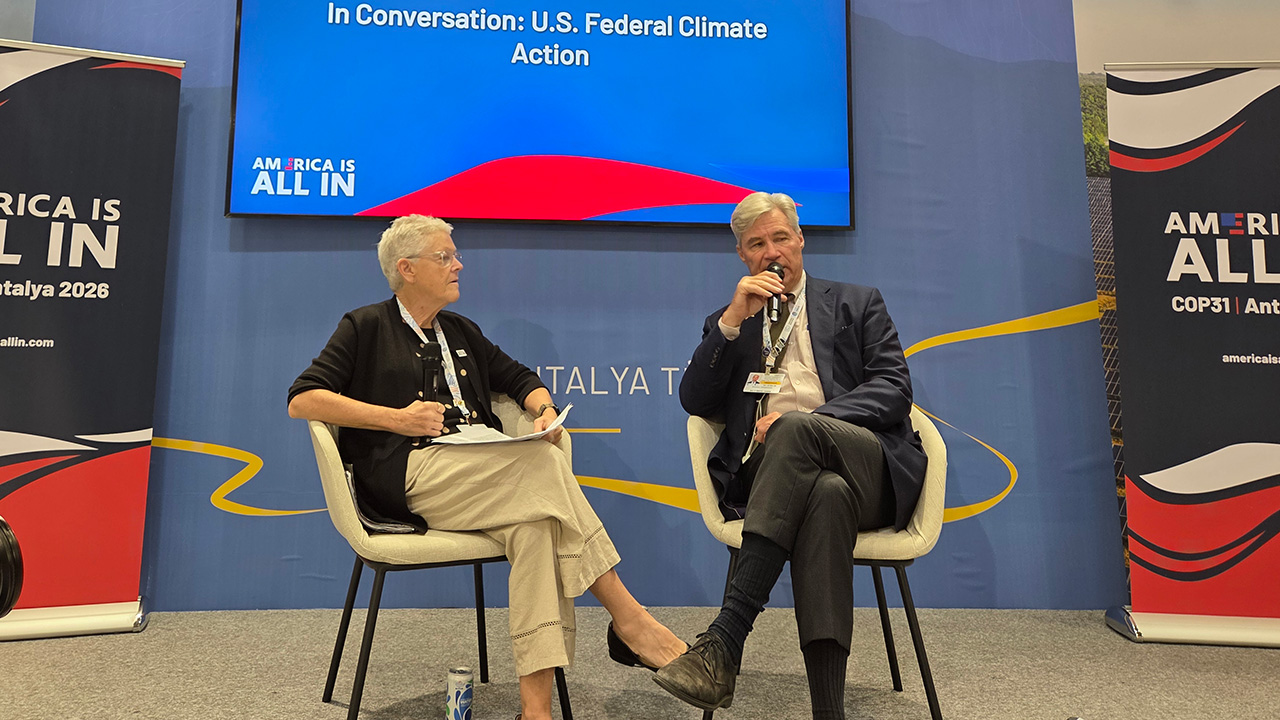
Sen. Whitehouse said if “pollute-for-free” persists as fossil fuels’ business model, that is wrong, morally and economically. He spoke about whole regions becoming uninsurable, leading to a mortgage market failure and a forthcoming crash in property values. Senator Whitehouse said the corrupt “death gap” of fossil fuels’ influence on our politics must be broken.
When Gina McCarthy asked his view of the midterm elections, Senator Whitehouse stated: “The American people spoke pretty damn clearly.” He went on to elaborate on the many new opportunities in the climate and energy space, and he pointed to wind power — which provides literally one-half-price electrons as a huge lift for American families.
November 16 | Launch of America’s Better Pathway Report
I began Day 4 in the front row for Nate Hultman, founding director of the Center for Global Sustainability at the University of Maryland. Hultman released their report “America’s Better Pathway: Charting the Affordability, Health, and Emissions Benefits of a Clean Energy Transition.” His team stated that renewable energy has been the primary source of new American electricity since 2016.
They quantified “America’s Current Pathway,” which continues existing policies and trends including federal policy rollbacks and subnational policies. They compare the results with “America’s Better Pathway,” which includes enhanced and additional subnational policies. The Better Pathway can power our economy with domestic energy that is more secure, affordable, quicker to deploy, and clean. In doing so, the Better Pathway can deliver better health, energy, and emissions outcomes — providing an immediate, available route to lowering household energy costs. The Better Pathway for the United States is within reach. This pathway accelerates a remarkable ongoing transition thanks to leadership from governors, mayors, and others committed to America’s clean energy future.
America’s Better Pathway projects a 38% to 46% reduction in greenhouse gas emissions by 2035 without federal action, compared to 2005. Additional subnational actions can build on and accelerate the downward trend in U.S. greenhouse gas emissions, which are currently 19% below 2005 levels.
The Current Pathway in comparison reduces greenhouse gas emissions only 22% to 32%.
The Better Pathway with enhanced and additional subnational policies drives greater renewable energy development, improves energy efficiency, and promotes more electrification across sectors.
In addition, the Better Pathway saves nearly $1,000 per household every year by 2035, with 5,000 fewer deaths per year by 2035.
All states would experience energy cost savings in the Better Pathway.
November 11 | COP31 negotiator’s non-ambitious CNN interview
I turned today to digging into Australia’s commitments to making bolder ambitions at COP31. The country is jointly leading this COP, with Chris Bowen serving as COP31’s Negotiations President and Australian Climate Change and Energy Minister. Many people here and worldwide are asking: what new ambitious actions will Australia commit to here in Antalya?
CNN apparently had the same question. Last night I was in the audience for Becky Anderson’s live interview with the Negotiations President:
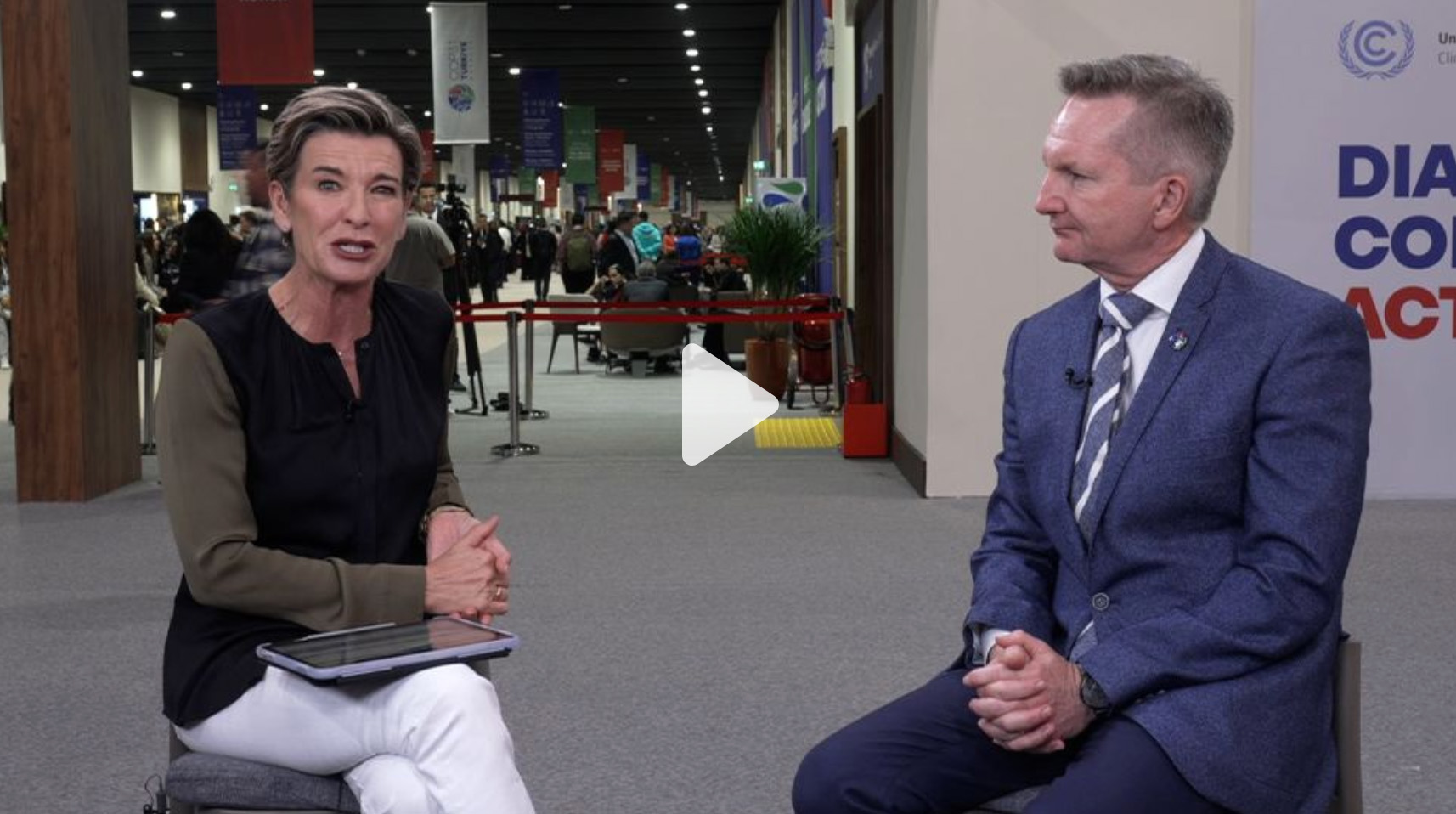
Bowen did not directly address the interviewer’s repeated question: when will Australia commit to phasing out coal? After all, the world expects the negotiations leader to approach climate diplomacy with a high bar of agenda items. Bowen did not rise to the level of the COP President at Dubai in 2023.
Bowen’s remarks began with a clear explanation of Australia’s increase from 33% renewable electricity in 2022 to 50% now, and tracking for 82% renewables by 2030. However, Bowen was complacent to leave 82% as “ambitious.” I objected to people standing near me: Minnesota is far more ambitious. In 2023 we passed one of America’s strongest climate laws, the 100% carbon-free electricity by 2040, and are now on that path.
COP31 Negotiations President told CNN: Almost all electrification is better in reducing greenhouse gas emissions. Bowen said electric vehicles (EVs) in Australia powered by 100% coal will get 60% reduction in emissions. He added: EVs powered by solar in Australia will achieve at least 90% emissions reductions. Bowen seemed content with claiming credit for the much higher efficiency of electricity.
Anderson asked Bowen: how will the country get more ambitious with the 35 by 2035 electrification goal set by COP31, up from about 23% electrification now worldwide — will Australia commit to phasing out coal?
But Bowen again did not directly answer the reporter’s question. He said that the globe has no chance of limiting warming to 1.5° C with the small increase in electrification rate in the world now. Electrification is happening at 0.3% per year. Bowen was right, that we need to increase the pace of electrification by at least four-fold, to 1.2% electrification each year across the world. But Bowen did not offer any new Australian commitments, and indeed Australia does not yet have an electrification plan to meet the 35-by-35 Global Electrification Pledge. I am disappointed in Bowen’s response and will be watching closely for any new climate actions I hope will flow forth from the critical, coal-exporting country.
In a separate speech, Chris Bowen did make a promise to Pacific Ocean small island developing nations. Bowen said this week in Turkey that COP31 must direct greater focus to oceans and correct a glaring funding disparity. “Oceans, the world’s largest climate regulator, have not received enough attention (at previous COPs). That changes here at COP31, and it’s not good enough that 0.2% of the world’s climate finance goes to small island developing nations for adaptation. That has to change.”
I’ll be watching for more climate financing arising for these susceptible nations at COP31. Join me for my webinar on November 23!
November 10 | Dispatch from the Canada Pavilion
Canadians have often been close to my heart as neighbors in my birthplace (New York State) and in my home now (Minnesota). When I saw the Canada Pavilion at COP31, I was glad to spend this day there — COP31 focused our attention on energy and transport. I attended two presentations by two very diverse teams. It reinvigorated my interest in different approaches to taking action on big climate problems.
First was Canada’s leading role in grid modernization and electrification. A speaker from the Pembina Institute laid out the challenges of moving a petrostate into an electric state, with the 35 by 2035 Initiative as the core. How was Canada to build “a cleaner, safer, healthier, more affordable country” as we must move forward to adapt to the “new” age of electricity? The single biggest lever to reduce greenhouse gas emissions by 40% is COP’s 35 by 35 renewable energy plan.
On the stage was Electrify Now’s Anna Freeman — an Australian — who introduced electrification as a big part of our 1.5° C goal but pointed out that globally we are nowhere near dealing with 35×35 electrification. She said that her country does not have a clear vision. In fact, only three places in the whole world — the EU, Canada, and France — have an electrification plan.
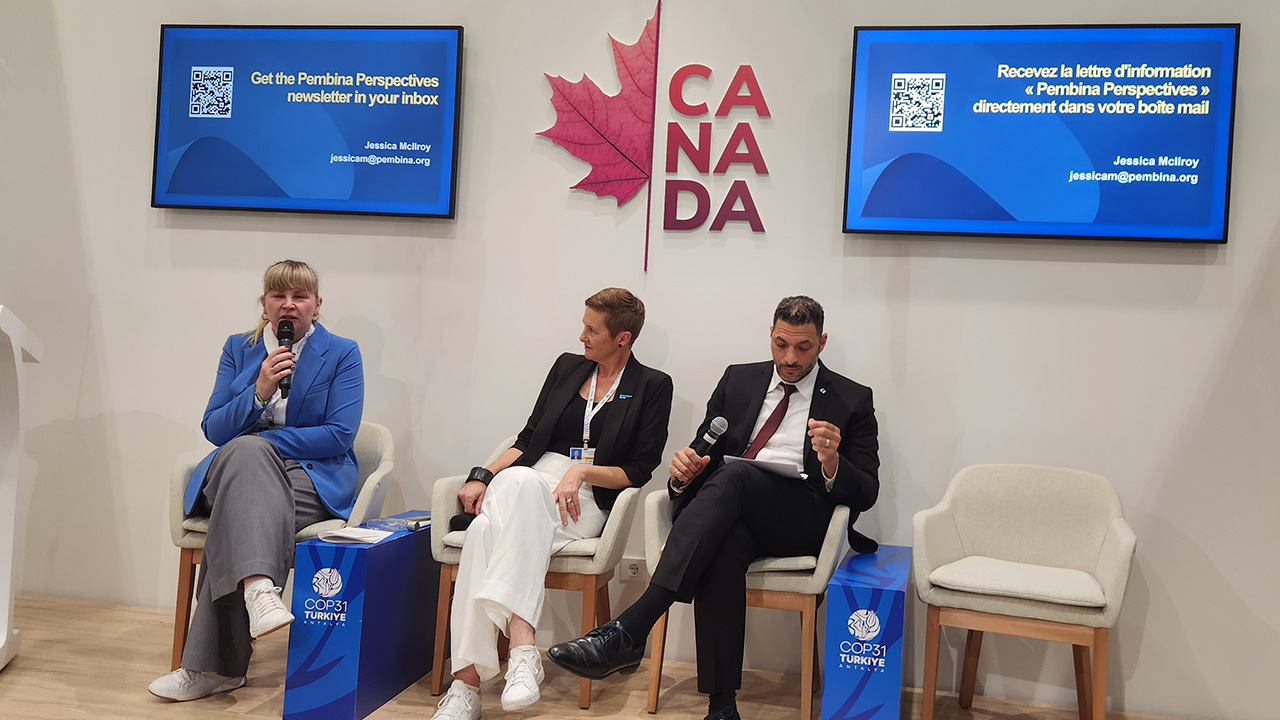
Freeman spent more time talking about the International Renewable Energy Agency’s (IRENA’s) flag that we need to build much more flexible storage to support our renewables goal. Australia provides the example: on July 1 this year the government started a 30% rebate on home batteries. Since July 1 about 2,000 home batteries have been installed every day! Yet Freeman rued the fact that policy that ensures batteries meet flexible storage that IRENA identified as a huge gap does not yet exist in Australia.
Next up was the Canadian CEO of Gestalt Communications. He provided ten minutes of thought-provoking ideas for how his firm is learning to convince their customers to join the electrification market. Ahmad Attia said this has more to do with human decisions than policy making. I was fascinated that Canada had invited both an Australian and an electric company to the discussion — it was eye-opening to have very different thinkers on the stage.
Today’s second panel was an expert group of people from around the world, all of whom were working on the ground on just energy transitions in practice. The panel focused on people-centered pathways from coal power to clean energy. Canada opened the conversation with a thoughtful set of invitations to reveal what speakers from South Africa, Germany, the Turtle Island Foundation, and Indonesia have discovered from their work in local and, of course, bottom-up communities.
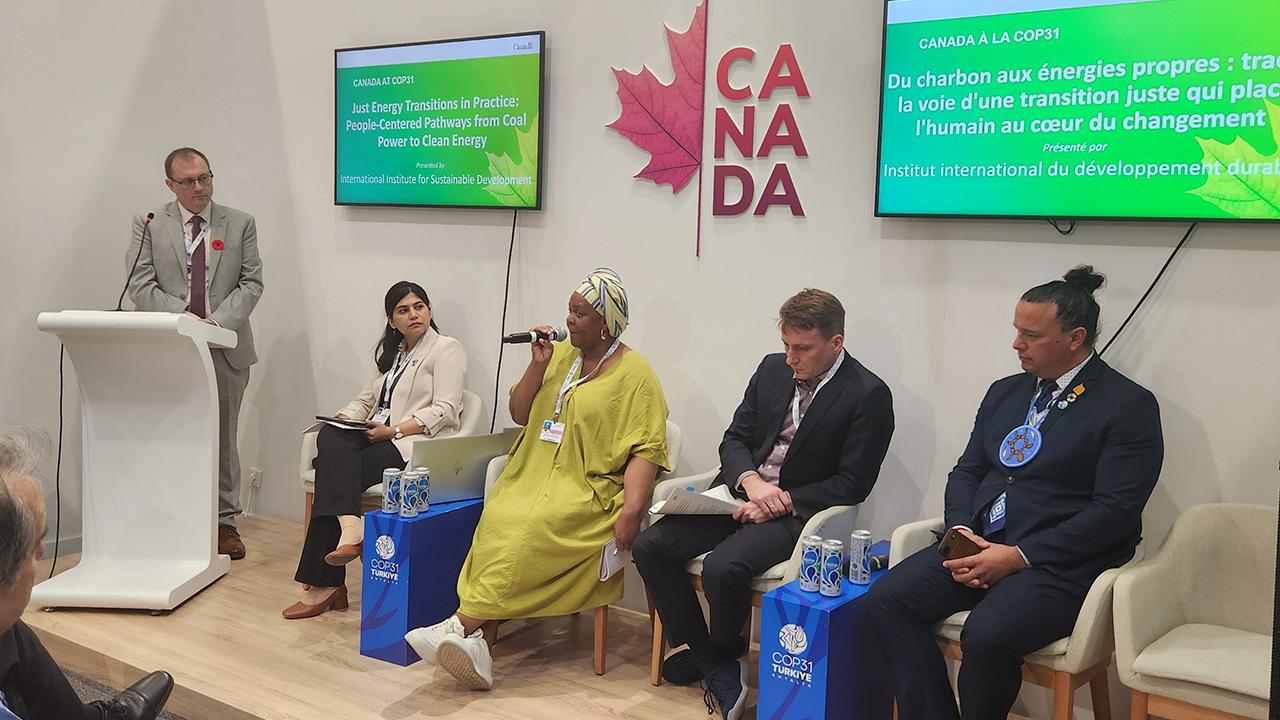
The hour-long discussion left me with lots of ideas for getting more voices into our work at Fresh Energy. I especially loved the comments of Keegan Leahy, a director at Iron & Earth, which reduces barriers to participation in Canada’s green economy. Leahy noted that this week they will announce the creation of the first Indigenous-led capital firm to fund renewable energy and storage projects that work to ensure that Indigenous people get the work, control the projects, and own the projects.
My morning at the Canada Pavilion highlighted all the speakers using the same language — for example, 35×35, clean energy transition, upscaling and rescaling fossil fuel workers, retiring a local coal plant — but each with a very local view of how to move forward on COP31’s goals.
It demonstrated again for me that nothing compares with having more people with local experience talk in person with many different people. That’s our best way to move forward, together, to benefit everyone.
November 9 | An update on day one
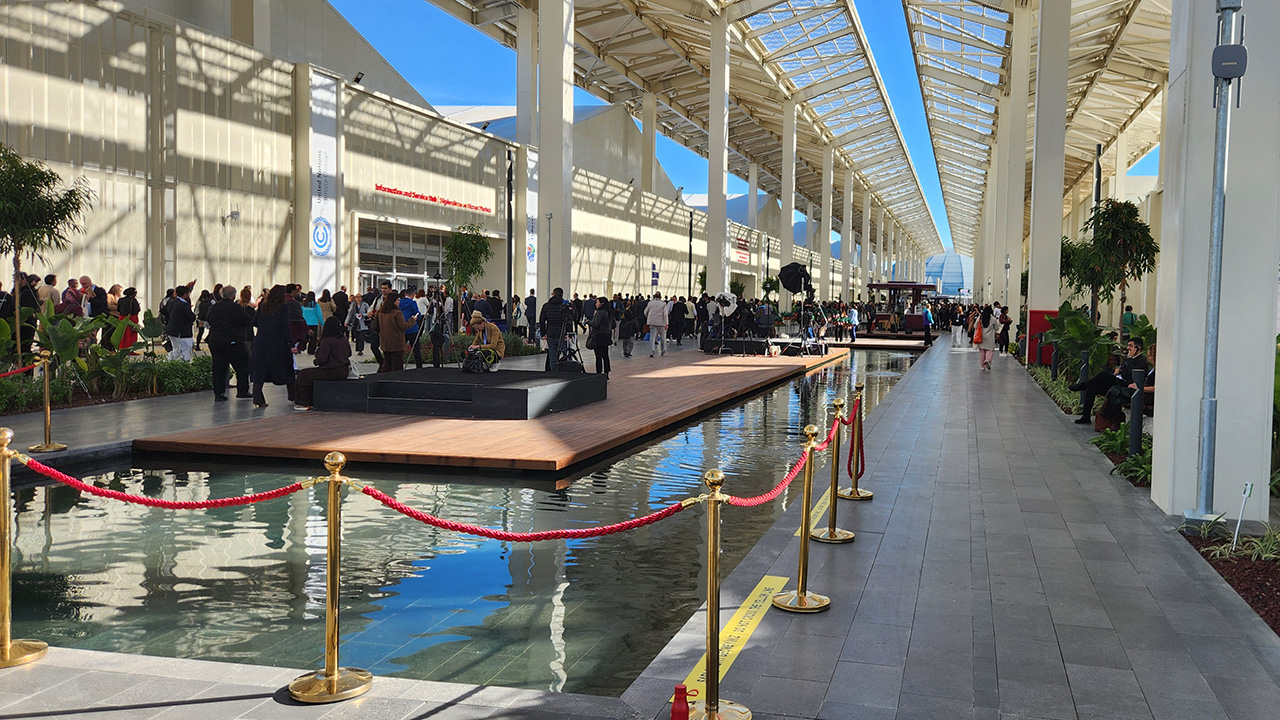
I am in Turkey at COP31, this year’s annual United Nations climate summit. The conference is at the Antalya Expo Center in Antalya, a Mediterranean resort city. It is the best COP site I’ve ever seen: easy-to-find rooms, plenty of space but easy to access all, and with good food (and free chocolate!). Negotiators, activists, scientists, and climate experts like me from nongovernmental organizations are gathering in the halls for the 11-day event that ends November 20. More (perhaps much more) than 60,000 people are expected from more than 195 countries that are Parties to the United Nations Framework Convention on Climate Change (UNFCCC), a treaty ratified by the United States in 1992.
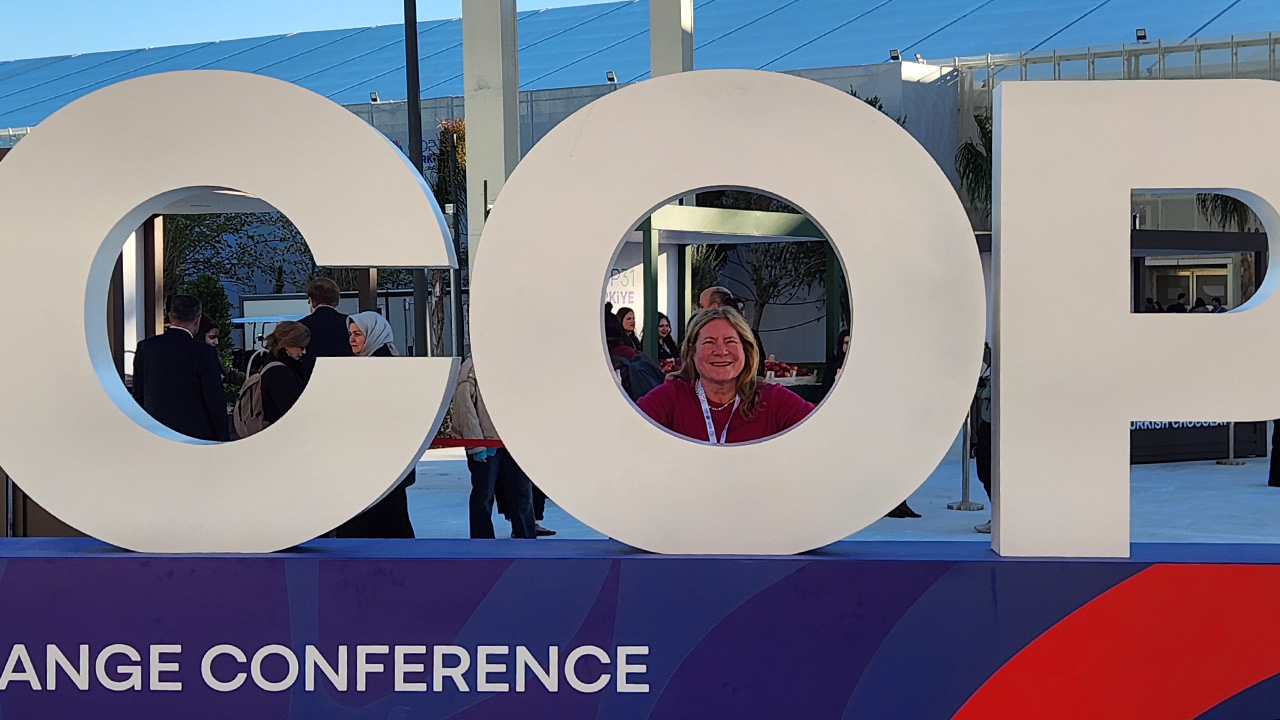
The talks were opened by the excellent Simon Stiell, UN Climate Change Executive Secretary. Stiell was clear: The top aim is to limit global temperature increase, and with speed and scale, cut planet-warming greenhouse gas emissions. COP31 must supercharge solutions: ones that deliver on the tripling of finance for adaptation “as agreed last year at COP30”; solutions that triple renewable energy by 2030. Developing countries still don’t have the funding they need to adapt to a hotter world and recover from increasingly intense disasters. He ended that negotiators need to follow through on the 2023 pledge to transition away from coal, oil, and gas. Stiell then turned over the podium to the first-ever TWO Presidents of a COP. Both COP31 President Murat Kurum, who is Turkey’s minister of environment, urbanization and climate change AND COP31 President of Negotiations Chris Bowen, Australia’s minister for climate change and energy. Remember that Australia will shepherd COP31 negotiations, and the negotiators must reach consensus on every sentence in the often 30-page text the UN produces at the end of each climate conference. Thus, the stakes are high.
President Trump will not be here, nor will any high-level representative of his administration. For the first time I remember, the U.S. does not have a pavilion called the U.S. Center to greet and talk with many citizens from across the world. At least 91 world leaders will be in Antalya as of November 11, including the prime ministers of Britain, Spain, and Brazil. I will report on what they strive for when leaders speak on November 11 and 12.
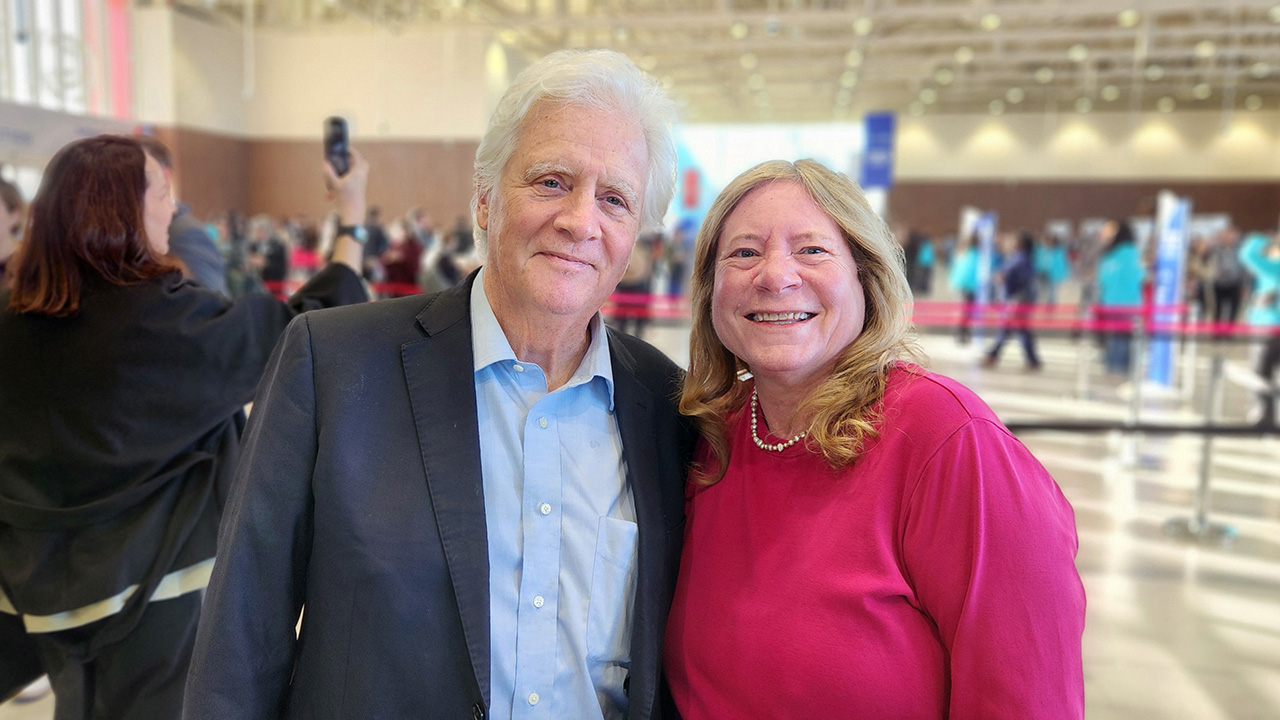
Here this morning the first person I recognized in the registration line was Trigg Talley, Special Representative of the U.S. to America Is All In (AIAI). AIAI is the primary pavilion I will be at for two weeks. Talley is one of the big reasons. He was a longtime career diplomat who served from 2005 to 2025 at the U.S. Department of State. He was the lead negotiator/head of delegation for the UNFCCC and the Paris Agreement. Now Talley helps AIAI guide and support American state and local government leaders cooperating outside the federal channels. The current administration has removed the U.S. from the UNFCCC and backtracked on most of the country’s climate laws. Non-federal actors here at COP31 continue cutting carbon emissions and driving clean energy transitions.
After several conversations with Trigg Talley, I proceeded directly to the America Is All In pavilion. AIAI this morning released a statement: 120+ U.S. states and local leaders are headed to COP31. 50 states are represented by AIAI, which in turn represents 63% of the U.S. population and 74% of the U.S. GDP. The pavilion will be the location of many U.S. speakers today and on November 12, 13, 14, and 16. The U.S. delegation was organized by AIAI, the U.S. Climate Alliance, and Climate Mayors. Expected are Gina McCarthy, dozens of members of the U.S. Congress, governors, and Mayor Nadia Mohamed of Saint Louis Park, Minnesota. New Mexico Governor Michelle Lujan Grisham will be here and said: “states and cities across the U.S. are undaunted, undeterred, and stand ready to strengthen our global partnerships.”
I will bring you — starting late this week — the robust climate actions that American leaders are sharing with the world.
November 9 | Türkiye, Antalya’daki COP31’den merhaba (Hello from COP31 in Antalya, Turkey)
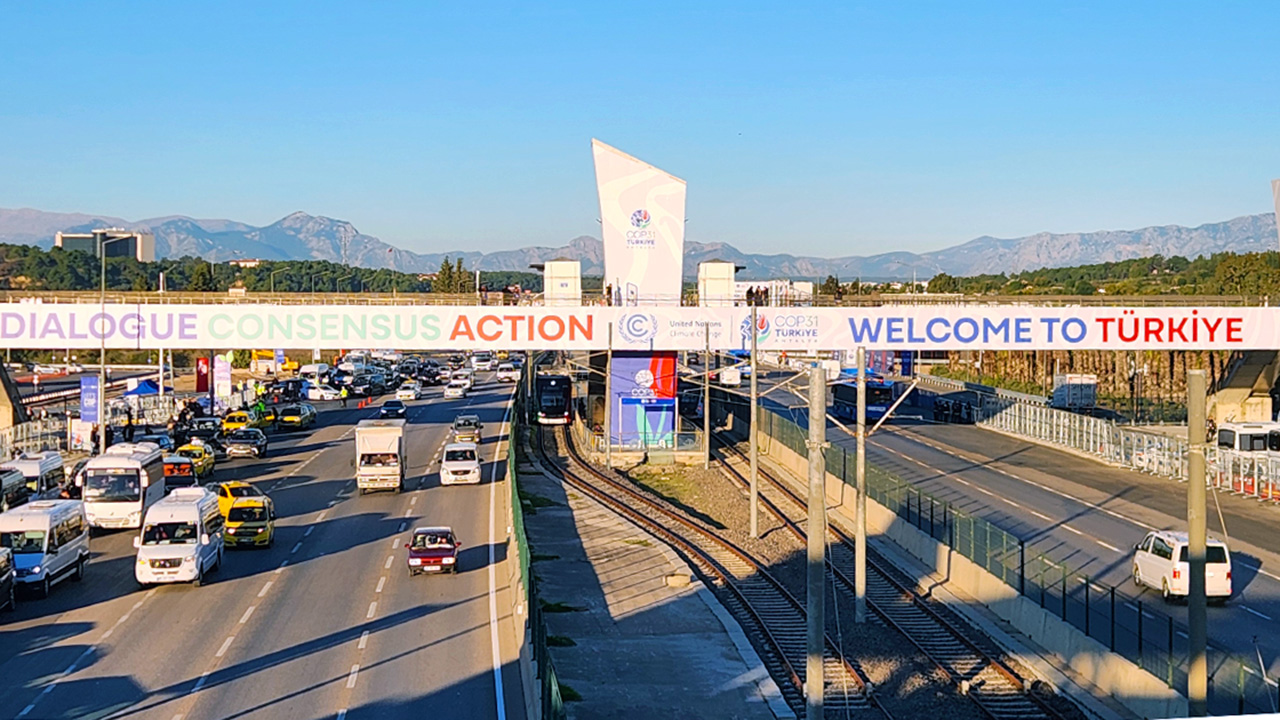
Today is day one of the 31st annual meeting of the Conference of the Parties (COP). Over its two-week run, an anticipated 100,000 people or more, including delegations from nearly every nation on Earth, will grapple with the profound planetary changes now underway and accelerating.
Conspicuously absent is the U.S. government. Back on January 7, 2026, President Trump signed a presidential memorandum and executive actions directing the U.S. to withdraw from the United Nations Framework Convention on Climate Change (UNFCCC) — a treaty that President George H.W. Bush signed and that the Senate ratified in 1992 — the Intergovernmental Panel on Climate Change (IPCC), and the Paris Agreement.
So while the Trump administration shares incorrect statements about human-caused climate change, America Is All In will have a prominent presence here at COP31 to convey to an international audience the significant climate action still taking place in the U.S. at the subnational level. This climate action coalition comprises over 5,000 members, represents two-thirds of the U.S. population, and accounts for 74% of U.S. Gross Domestic Product. Members include thousands of U.S. cities, states, tribal nations, businesses, schools, and institutions of faith, health, and culture (including the Science Museum of Minnesota).

Today, America Is All In, the U.S. Climate Alliance, and Climate Mayors announced a U.S. delegation of more than 120 congressional, state, local, and cross-sector leaders will be attending COP31. Their presence will demonstrate the strength of U.S. subnational climate leadership and a commitment to building partnerships and solutions that lower carbon emissions, reduce pollution, and improve people’s lives everywhere, despite federal intransigence.
A big boost going into COP31 is the outcome of the U.S. midterm elections last week. While those elections will not alter Trump’s hostility to climate action, they will usher in a new Congress that will work to accelerate a clean energy economy that creates good-paying jobs, helps lower people’s utility bills, and reduces emissions of planet-heating gases.