
The 30th Conference of the Parties (COP30) to the United Nations Framework Convention on Climate Change was held in Belém, Brazil from November 10-21, 2025. J. Drake Hamilton, managing director, science policy at Fresh Energy, attended the conference virtually. This blog post contains her near-daily reflections from the convening.
December 3 | Webinar – COP30 and Fresh Energy – A Discussion with J. Drake Hamilton
J. hosted a webinar on December 3 to debrief outcomes and answers participant questions about the event. Tune in here or listen on our podcast, “Decarbonize: The Clean Energy Podcast.”
November 21 | Parties continue negotiations for funding clean energy transition and adaptation
The Presidency shuttle diplomacy on the Belém text proposal continued throughout last night and into the rest of today. The summit president has warned “everybody will lose” if countries fail to cooperate to preserve the Paris Agreement.
A critical part of the Paris Agreement — finance from richer nations for a clean energy transition and adaptation — is not yet in the COP30 text. Political leaders from wealthier countries must show today a willingness to meet their responsibilities to fund climate action in poorer nations.
Yesterday afternoon a fire occurred in the pavilion area of COP30’s Blue Zone, where delegates were. The area was evacuated and reopened at 8:40 p.m. in Brazil. Thank goodness, the fire caused no injuries.
A deal text would need approval by consensus among 196 countries present in order to be adopted.
As I write this, Parties are still negotiating.
November 20 | Proposals inch closer for adoption
The COP30 President announced his intentions to the Parties and observers of the current planning for work on Thursday and Friday. The COP Presidency will undertake shuttle diplomacy on some of the text proposals that have been made. As these draft decisions are ready for adoption, they will be added to the list of decisions completed on Friday.
Please stay tuned for the final text; know that it may be available after Friday, November 21.
November 19 | COP30 celebrates High-Level Champions, works into middle of night for solutions
I watched the closing of the Global Climate Action High-Level Champions Event with a very large plenary audience in Belém. It was billed as “Connecting Solutions and Accelerating Implementation Actions.”
UNFCCC Executive Secretary Simon Stiell called this “the COP of Truth” and “the COP of Implementation.” He cited the decision to quadruple global renewable fuels by 2035 as a transformational step in the Climate Action Plan they’ve created. “It is mission-critical, a key part of the Paris Agreement,” he said. The COP President notes that “Progress spreads when it is shared. The High-Level Champions have made progress with governments, markets, and communities working together into scaled-up results demonstrated in the Climate Action Plan.”
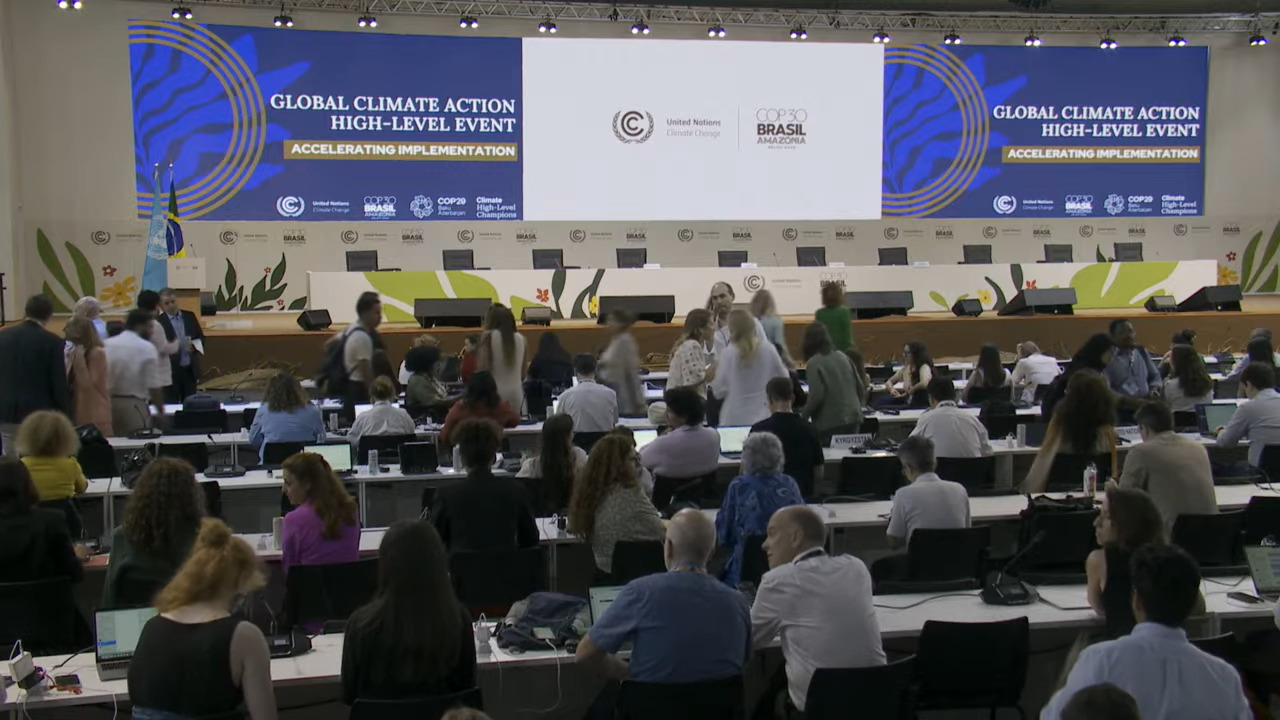
The event closed with the last speaker raising the need going forward for “implementation 365 days of each year.”
Tonight, like last night, negotiators will be working together past midnight until the work of the Parties is finished, with a deadline Friday night or Saturday morning.
November 18 | The President calls on all negotiators to join collectively in mobilization of minds, hearts, and hands
COP30 President André Corrêa do Lago has sent a letter to all the Parties, asking them all to work side-by-side “in task-force mode” to deliver the Belém Package by accelerating the pace focusing on what unites us for the climate and humanity. He proposes that they complete a significant part of our work by Tuesday evening so that they can gavel in the package at a plenary session by the end of Wednesday.
After all, Parties started last week by standing united in celebration of the 10-year anniversary of the Paris Agreement. Now the policies of the Paris Agreement are now in full motion. The COP President spurs all Parties to respond to needed urgency through accelerated implementation of the Paris Agreement, solidarity, and international cooperation. All other items will be completed on November 21.
Onward!
November 17 | Countries make new commitments as decisive week of COP30 kicks off
This past weekend marked the midpoint of COP30. Today, I watched the High-Level Ministers — over 160 of them — begin the incoming High-Level Segment of Ministers or high-level officials speaking live in Belém. The COP has now entered into its decisive week. What do we need from the final second week of COP30?
I was glad to hear Party after Party (country after country) declare we must keep the 1.5-degree Celsius goal within reach. Norway reminded the Parties that in Dubai two years ago, “we agreed to transition away from fossil fuels.” The UN is now accelerating the climate negotiations, reminding Parties that they are all here to translate ambitions into global-level results, that we have shared responsibility for human-led shared future. The time is here and now, said the COP President this morning.
Can the countries close the emissions gap, elevate adaptation, connect nature and climate, and lock in a credible plan to mobilize and deliver the needed finance? Can COP30 deliver hope for the future for both people and the climate?
Multiple Parties made new commitments as they advanced their Nationally Determined Contributions. I just heard Azerbaijan, Finland, and Romania describe their accelerated commitments. South Korea, which operates the world’s 7th-largest coal fleet, over the weekend made its official commitment to phase out 40 of its 61 existing coals plants by 2040.
We must hear many, many more aggressive climate action plans this week. And then we need to get all nations to agree on the decisive text coming out of COP30, line by line and word by word, as consensus is required.
I expect that the negotiations will go on 24/7 for the last days of this week. Stay tuned here and register for my webinar on December 3 for the full results!
November 14 | The US has not a sent a delegation for the first time in COP history
194 Parties are in-person at the Belém Climate Summit, with a total of 56,118 delegates registered. 11, 519 people represent their countries officially. They are from 193 countries plus the European Union. Not at COP30 are officials from the U.S., Afghanistan, Myanmar, and San Marino, all not registering a delegation for the summit.
In contrast, 198 countries are Parties to the 1992 climate treaty, the UN Framework Convention on Climate Change (UNFCCC). For the first time in the history of COP climate summits, the US — the world’s largest historical emitter — has not sent a delegate to this year’s talks. Treaty signers started meeting at COP1 in Berlin in 1995.
COP30 has the largest number ever of “virtual” delegates, including myself and at least 10,000 others. We were beriddled with the shortage of beds in Belém and sky-high accommodation costs.
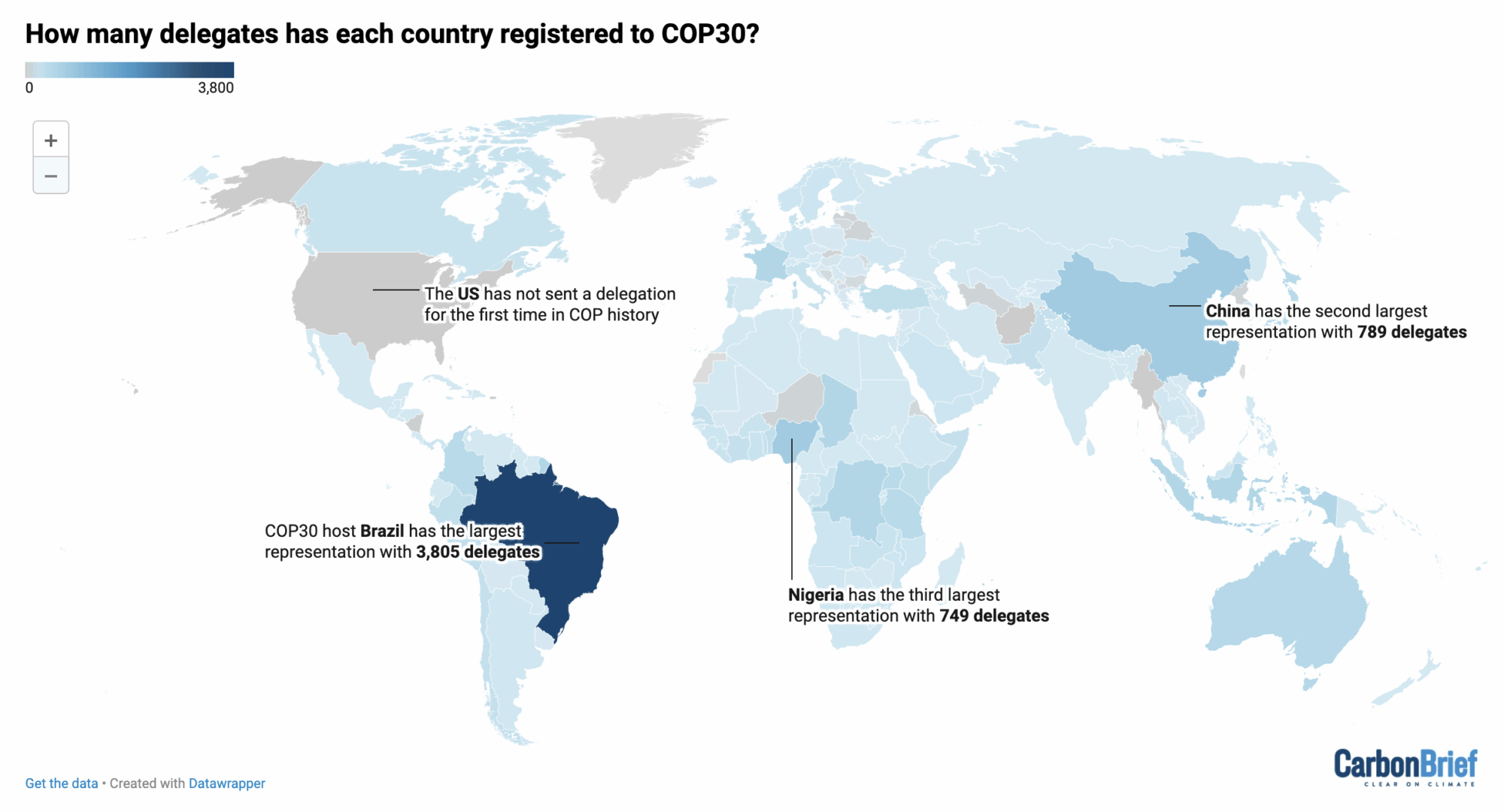
The largest representation is from Brazil, with 3,805 delegates. China is the second-largest with 789 delegates, Nigeria third with 749 delegates. The smallest delegation is one person representing Nicaragua, and two people are representing North Korea.
Media badges are numerous, with 3,920 reporters present. COP30 is the summit with the most women in-person in history — 43% women, 57% men.
November 13 | Renewables and electrification will dominate the future.
The annual World Energy Outlook has been released by the International Energy Agency (IEA), coinciding with COP30.
IEA’s summary: Renewable energy led by solar power will grow faster than any other major source in the next few years, and coal and oil demand will likely peak globally by the end of 2030.
“The evidence on the ground is overwhelming. EV sales are taking off in many emerging countries; solar is permeating even through the Middle East,” said Dave Jones, chief analyst at global energy think tank Ember.
Four countries or groups of countries are responsible for most of the world’s greenhouse gas emissions:
China: 32%
U.S.: 13%
India: 8%
European Union: 6%
The IEA report found that over the past decade, 35 countries saw a consistent decrease in their emissions. That is 67% improvement over the previous decade, when 21 countries saw a consistent decrease in emissions. COP30 President Stiell noted: “Progress has been real. But it’s not nearly enough.”
November 12 | Rapidly-growing countries accelerating green economic growth
Today, COP remains essential as the only forum in the world that gives equal voice to countries — rich and poor — to negotiate with the others on addressing climate change. This is particularly important regarding questions of finance, which are fundamentally questions of justice.
Think of COP30 having three “groups” of countries: the first group of countries are high-income countries, which are primarily tasked with decarbonizing their economies and doing their part of reaching our goal of achieving no more than 1.5 degrees C of warming. Examples include the United Kingdom, Sweden, Denmark, and (absent from COP30) the federal delegation of the U.S.
The second group of countries are vulnerable and lower-income countries, who contain about 3.45 billion people at highest risk from climate change.
But I am focusing more and more on the third group of large, middle-income countries, which must decarbonize while accelerating green economic growth. Examples are numerous at COP30, including Brazil, China, India, Indonesia, Mexico, Columbia, and South Africa.
The New York Times reported that “a surprising shift is taking hold in many large, fast-growing economies where a majority of the world’s people live. Countries like Brazil, India, and Vietnam are rapidly expanding solar and wind power … Nigeria, a petrostate, plans to build its first solar-panel manufacturing plant … Santiago, the capital of Chile, has electrified more than half of its bus fleet in recent years.”
Let’s think about China. China’s announced climate targets — cut greenhouse gas emission by 7 to 10 percent by 2035 — may seem tepid. But President Xi’s pledge that China will add six times the amount of solar and wind energy it had installed in 2020 and ensure that 30 percent of its energy comes from non-fossil fuel sources by 2035, means that China is likely to go far beyond its announced COP target.
China is now the world’s clean tech superpower. Today, China manufactures over 80 percent of the world’s solar panels and now installs more solar panels annually than the rest of the world combined. Interestingly, China today exports and finances solar panels, wind turbines, and batteries to saturate energy-hungry, less developed countries. China is investing billions into clean energy and clean car factories in Vietnam and Brazil.
The President of the Belém Climate Summit has said that new countries are appearing at COP30 with a different role: showing climate solutions to the other two groups of countries. Bravo! President Corrêa do Logo asserts: “You can’t insist that China has to lower its emissions … and complain that China is putting cheap EVs all over the world. If you are worried about climate, this is good news.”
We should be paying attention to large, emerging countries, because they have the most people in the world and also the largest number of poor people, with rapidly growing energy demands. If the emerging countries don’t change, there will be no chance for the globe to reach a safer place.
November 11 | Paris Agreement driving down emissions
UN Climate Change Executive Secretary Simon Stiell announced at the Belém Climate Summit: “We are now bending the curve of planet heating emissions downward — for the very first time. The Paris Agreement is delivering real progress.”
Here is the United Nations chart from the updated NDC Synthesis Report from November 9, comparing the projections before and immediately after the Paris Agreement.
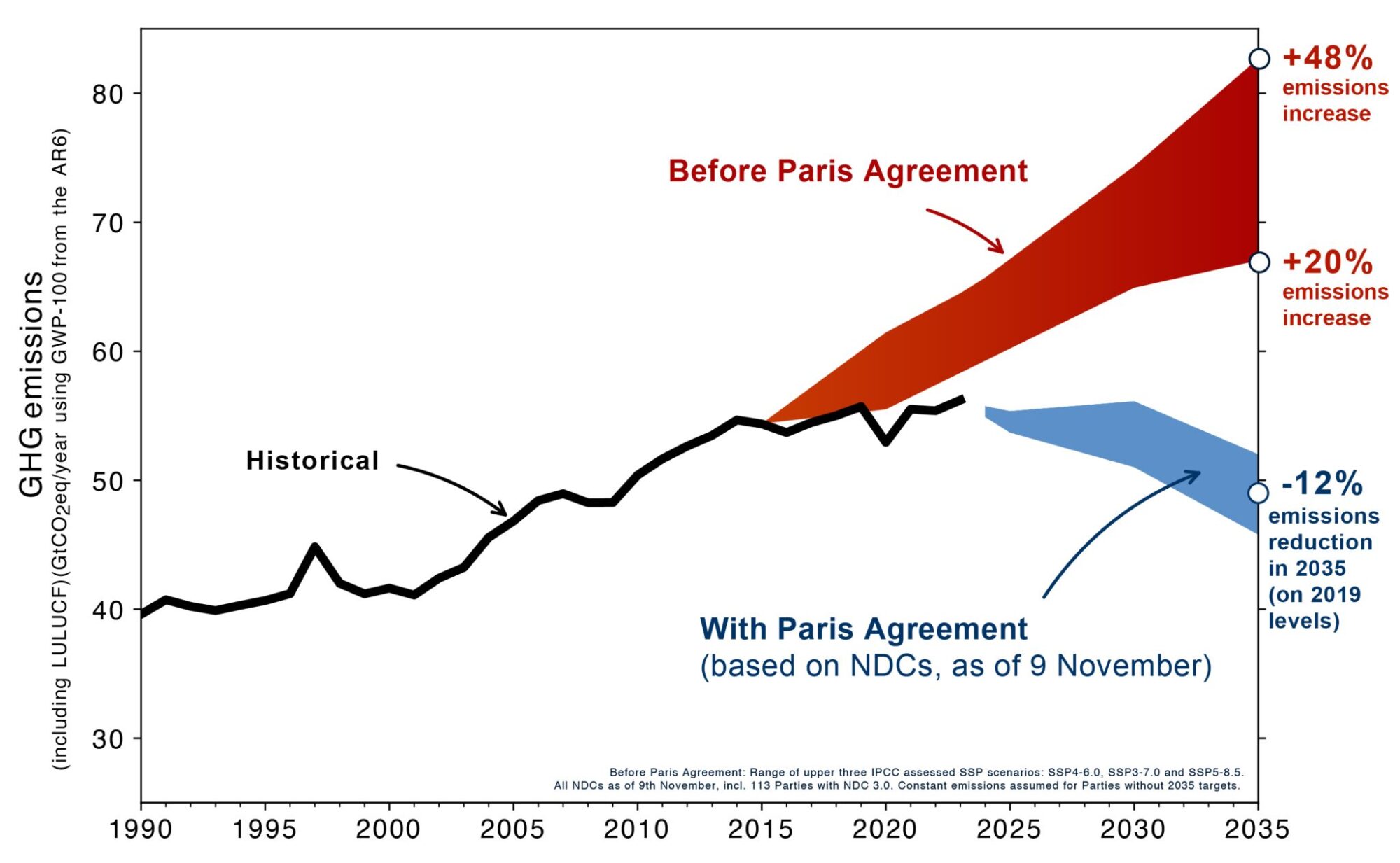
“The thus-far announced new Nationally Determined Commitments will decrease emissions by 12% in 2035. That is a huge gap,” Stiell emphasized. “We must strive valiantly in Belém for more.”
November 10 | COP30 begins in Belém, Brazil
The two weeks of the global climate summit kicked off on Monday in the lush Brazilian city in the Amazon.
Brazilian President Lula (his full name is Luiz Inacio Lula da Silva) was at the front of the large plenary room that seats about 1,000 people.
The UNFCCC Executive Secretary Simon Stiell addressed the Plenary saying, “In Belém at the mouth of the Amazon, with more than 1,000 tributaries coming together, we must act in the same way, all of us together at Belém.”
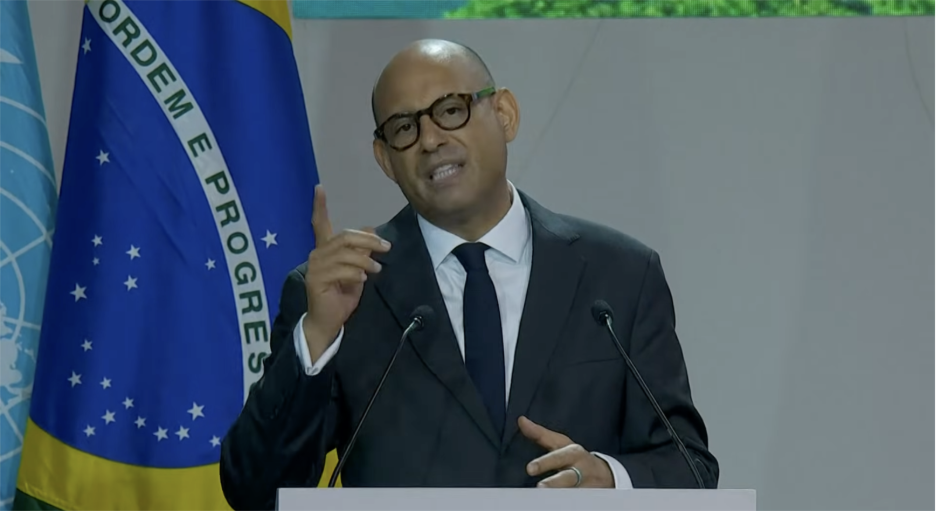
“Renewables overtook coal earlier this year as the world’s top energy source. We already agreed at COP29 we will transition away from fossil fuels.” said Stiell. “Now we must agree how to do it. We all agreed to triple renewable energy, to double energy efficiency, to raise $300 billion by 2035 in climate finance for the most vulnerable nations toward the needed total $1.3 trillion from every source.”
“It is entirely to every nation’s benefit to do this,” he said. “To make the economic transition of this age. We need to fight climate change together. We must move much, much faster on reducing emissions and increasing resilience. We need solutions at work.”
I’ll be tuning in to the important plenary sessions, as well as meetings to work toward the final Belém definitive text over the course of COP30 the next few weeks. Remember: each COP text must be agreed to by consensus from all Parties to the UNFCCC treaty. Stay tuned for updates on this page, and be sure to register for my upcoming webinar on Dec. 3 where I’ll debrief the outcomes from COP30 and answer your questions.