
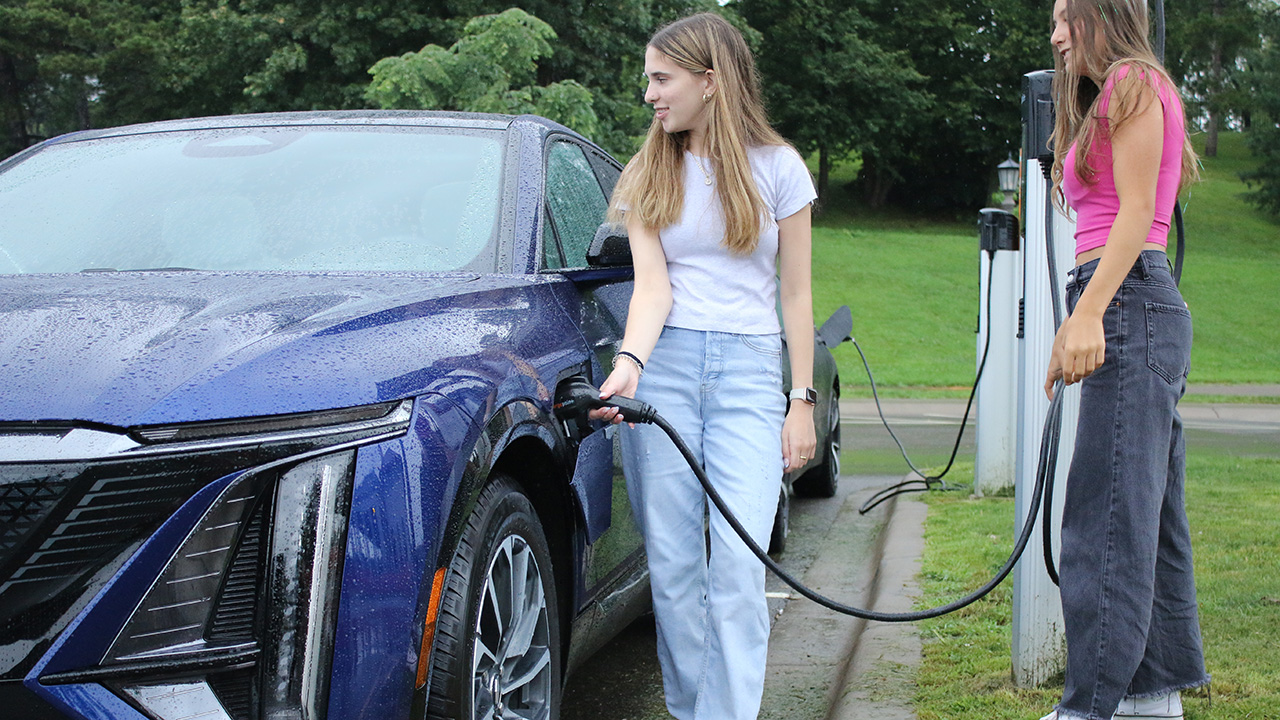
Electric vehicles (EVs) are growing in popularity across Minnesota, and with gas prices on the rise and plenty of EV models now available, more drivers than ever are curious about making the switch.
To help answer the questions on everyone’s minds, Fresh Energy hosted its annual EV Outlook webinar, bringing together Jukka Kukkonen, our transportation consultant and founder of “Shift2Electric;” Anjali Bains, our managing director, transportation; and Nick Haeg, our senior associate, electric vehicles, for a wide-ranging conversation on the state of EVs in 2026.
Read through the highlights from our conversation, and be sure to watch the full webinar above to get all the details!
This article has been edited for length and clarity.
What’s the state of the electric vehicle market in 2026?
Jukka opened his portion of the webinar by introducing a phrase that’s become newly relevant: gas price anxiety. Remember range anxiety — the worry that your EV wouldn’t have enough juice to get you where you needed to go? With the average new EV now offering over 290 miles of range, that concern has largely faded. In its place, drivers of gas-powered cars are increasingly feeling the sting of volatile fuel prices.
“Gas prices are up, and there are many more people that are looking into EVs right now,” said Jukka. “You cannot rely on where gas prices will be.”
Globally, the EV market continues to surge. China alone sold nearly 13 million EVs last year — more than the entire North American light-duty vehicle market. Norway hit 98% EV market share in a single recent month. Denmark was at 82% last month. The world is moving forward, even if the U.S. is facing political headwinds.
One of the most compelling parts of Jukka’s presentation was a breakdown of why EVs simply make more technological sense. Internal combustion engines are only about 15–25% efficient in real-world driving — most of the energy in gasoline is lost as heat. Electric motors, by contrast, are 85–95% efficient. That’s roughly four times better. And as Jukka put it, “If you have any technology that is four times more efficient than the previous technology, it will take over. There’s no question about it.”
Battery life, charging, and other common concerns
Jukka spent time addressing some persistent myths that still hold people back from getting their first electric car. After getting one, he notes, these concerns go away once people find out how much they love their EV.
EV batteries do not wear out quickly or need replacements often. Data from over 30,000 EV owners shows that 92.5% of EVs that are 10 years old still have their original battery. A separate study testing nearly 80,000 EVs found an average battery health of 92%. Jukka’s family drives three used EVs, all with over 130,000 miles on them, and he says battery degradation simply isn’t a big concern.
Charging doesn’t take very long, and it’s getting much faster every year. Home charging with a Level 2 charger means plugging in at night and waking up to a full battery — no different from charging your phone. For road trips, public fast charging keeps improving. In 2025, over 18,000 new DC fast-charging ports were deployed in the U.S., a 30% increase over the prior year as more people switch to EVs. The standard fast-charging power for new vehicles is now around 150 kilowatts, with some chargers hitting 300 kilowatts (kW). Jukka predicts that by 2030, ultra-fast 1,000 kW chargers will be available — meaning you could add 200 miles of range in about four minutes.
There are more and more chargers available for longer road trips. All new EVs can now use Tesla’s Supercharger network, dramatically expanding the charging options available to drivers. Commercial charging providers like Electrify America, Ionna, and EVgo are rapidly expanding, and they’re increasingly able to do so profitably
2026 is a great year to buy a used EV
One theme Jukka returned to several times: right now is an excellent time to shop for a used EV. Leasing rates for EVs climbed sharply starting in 2023, when Inflation Reduction Act tax credits became broadly available for leased vehicles. Those three-year leases are now coming back off the lots in large numbers, flooding the used market with relatively new, well-maintained EVs. If you’re price-sensitive, used Nissan Leafs and Chevy Bolts can be found for under $10,000. For $15,000–$20,000, your options expand considerably, including models like the Hyundai IONIQ 5 and Kia Niro EV.
On the new vehicle side, there’s plenty to watch. The new Nissan Leaf now starts under $30,000 and offers a bigger battery and faster charging. Chevrolet has brought back the Bolt. The Rivian R2 just announced pricing. Battery prices overall continue to fall — Jukka shared that a 5 kilowatt-hour (kWh) battery pack he paid $3,000 for in 2024 now sells for $675.
Federal EV policies are hindering America’s transition to electric vehicles
While Jukka painted an optimistic picture of EV technology and the market, Anjali provided important context on the policy environment, which has been turbulent.
The transportation sector is the largest source of U.S. greenhouse gas (GHG) emissions and Minnesota’s emissions. Most of these emissions can be reduced by switching our gas-powered cars that run on gasoline to instead be electric vehicles powered by a clean electricity grid. Fresh Energy advances bold policy across multiple sectors in Minnesota to ensure this transition happens as quickly and equitably as possible.
But that progress has been stalled at the federal level. In early 2025, the Trump administration moved to freeze National Electric Vehicle Infrastructure (NEVI) funding, the program established under the 2021 Bipartisan Infrastructure Law (also known as the Infrastructure Investments and Jobs Act) to build out a national public charging network. In response, seventeen states, including Minnesota, sued, and earlier this year in January a federal judge directed the Department of Transportation to stop blocking those funds.
However, soon after that ruling, Congress passed the 2026 federal appropriations bill, which included $500 million in NEVI claw backs, primarily affecting states that had been slow to deploy or obligate their funds. A separate $300 million claw back from the Charging and Fueling Infrastructure program may affect four Minnesota awardees, including MnDOT, Hennepin County, and the Met Council. Soon after, the administration also separately moved to fully freeze these charging grants to four states — California, Illinois, Colorado, and Minnesota — in a move Anjali described as clearly politically motivated.
An effort to reconsider the “Buy America” waiver for federally-funded EV chargers is also underway, with Fresh Energy helping to gather and submit 32 public comments against this proposal through our Action Alert. Minnesota’s Attorney General joined 19 other attorneys general and the governor of Kentucky in submitting a letter against this proposal. A final decision is expected later this spring by the Federal Highway Administration.
Minnesota is charging ahead with electric vehicle policy
At the state level, last session’s budget deal increased Minnesota’s EV surcharge to an MSRP-based (Manufacturer’s Suggested Retail Price) calculation with a floor of $150 — double the previous EV surcharge — and added a new 5-cent-per-kilowatt-hour public charging tax set to take effect in 2027.
Having raised major concerns on this approach last session and during a subsequent working group, Fresh Energy is supporting a bill, House File 3430, that would reduce the surcharge back to a flat $100 fee and offset lost revenue with a weight-based multiplier affecting all vehicles, not just EVs. The bill was heard in the House Transportation Committee last week, and while its chances of passing this session are limited, it signals interest from lawmakers toward fixing what passed last year.
Aside from the Legislature, Minnesota’s electric utilities are doing their part to support EV adoption through their Transportation Electrification Plans (TEPs) they file with the Minnesota Public Utilities Commission. Nick provided an overview of how Xcel Energy — which serves nearly half of Minnesotans — is increasing its investments in “make-ready” charging infrastructure, including for multifamily residents and public charging, as well as rolling out an active managed charging program that would help integrate more clean energy with EVs and prevent strain on the electric grid. Xcel is also updating the popular Accelerate At Home program to now accommodate customers with rooftop solar. Minnesota Power and Otter Tail Power are also expanding their EV programs, including new rebates and load control options for EV customers in greater Minnesota.
What’s next?
From battery technology to used car deals to utility programs, there’s a lot of good news for Minnesotans considering electric vehicles right now. Fresh Energy will continue working to advance EV adoption across the state — because getting more people into electric cars remains one of the most effective things we can do to reduce transportation emissions, the largest contributor to climate pollution in Minnesota.