
This is Part I of II in a blog post series on energy affordability, building codes, energy efficiency, and a healthy climate. Read Pt. II here.
In February 2026, my home’s utility bill was the highest we’ve ever seen: over $820 for gas and electricity. We could pay it, but for too many people this would have been a life-altering bill.
In 2025, over one-third of U.S. households skipped or cut back on medication, food, or other necessities to pay an energy bill. A quarter were unable to pay an energy bill in full, and in 2024, 2.7 million households had their utility service shut off due to non-payment.
A lack of affordable housing, rising energy bills, and increasing greenhouse gas emissions threaten the health and wellbeing of all Americans.
These interconnected problems won’t go away on their own. Energy prices are likely to keep going up. But despite volatility and upward pressure on energy prices, there is still a lot that Minnesota’s decision makers can do to keep bills from skyrocketing.
One of the best policy tools we have to address these problems is the energy code: by making our homes more energy efficient, we can also make them more affordable and emit fewer climate-polluting gases.
Efficient homes are more affordable than inefficient homes
My home’s $820 bill covered a lot of expenses from my utilities. Some is for input costs like fuel and electricity generation. Some goes to infrastructure like distribution lines, transformers, or large transmission lines. The utilities are also allowed to generate a profit, which is regulated by the Minnesota Public Utilities Commission. It’s also affected by the outdoor temperature and the indoor thermostat set point; this winter had some bitterly cold days in Minnesota.
However, there is another important factor that doesn’t get a line on your bill and determines how expensive utility bills will be for decades to come: how energy efficient your home is.
The efficiency measures implemented during the design and construction are the first, and some of the most important factors impacting how costly a home’s monthly energy bills will be. It’s also an opportunity: if we can build more homes to be more efficient, many more Minnesotans will have lower utility bills for decades.
The initial energy efficiency of my home was set during construction. That is where this 100-year-old house falls short. It has, at best, half an inch of insulation in some of the exterior walls.
I love our old house — but it wastes a lot of energy. Most of the heat released by our boiler and radiators in the winter goes right out the windows, walls, and roof. While we have insulation on our project list, it’s difficult to prioritize saving for it among other necessary home projects and higher monthly bills, so winters can get expensive.

We can’t rewind time and put thick insulation in all old homes to help Minnesotans have lower energy bills every month. But we can support stronger energy codes so that our homes going forward are more affordable over the long-term. Fresh Energy works on much more than building codes — we also support policies that improve efficiency in existing buildings, such as the Energy Conservation and Optimization (ECO) Act, weatherization, home energy rebates, building performance standards, and beyond.
Improving energy efficiency of homes through Minnesota’s landmark energy code acceleration laws makes housing more affordable and helps reach our state’s climate targets. In 2024, the state legislature wisely turned up the dial on our residential energy code by requiring “near-zero” super-efficient new homes by 2038, with incremental improvements every three years along the way. These code updates will help ensure Minnesota steadily builds cleaner, more affordable homes as we reach net-zero emissions by midcentury.
By maximizing efficiency from the start, Minnesota residents can avoid numerous costs associated with home energy use: 1) high monthly energy consumption, 2) expensive and invasive retrofits to improve insulation and air sealing after construction, and perhaps the least obvious, 3) more utility infrastructure upgrades to meet the higher peak demands of less efficient buildings.
There is only so much we can do at the local level to protect energy affordability for the people of Minnesota. We cannot control global natural gas/methane prices, the cost of transformers or other grid infrastructure, or the tariffs and taxes the federal government is applying to our cheapest forms of renewable electricity generation. However, we can use our energy codes to preserve affordability for the future Minnesotans by constructing buildings to be more efficient. As the minimum standard for all new construction in the state, our energy code is an under-appreciated policy tool for lowering emissions and keeping energy bills lower.
Unfortunately, not everyone is on the same page when it comes to Minnesota’s buildings. During the 2026 legislative session, a few well-resourced home building companies, many of which are from out of state, have attempted to undo our state’s progress on building codes by trying to repeal the 2038 near zero requirement and lock Minnesotans into less efficient, more costly homes for decades.
The good news is the attempt failed to make it out of the House Workforce, Labor, and Economic Development Finance and Policy Committee after Fresh Energy and a large group of efficiency champions, including members of the Minnesota Efficient Builders Coalition (MnEBC), showed up and spoke up to defend energy affordability. The bad news is we expect this pushback on progress to continue.
But Fresh Energy staff and our partners at the MnEBC and beyond are ready and laser focused on ensuring Minnesotans understand that there is no housing affordability without energy affordability; and there is no energy affordability without efficiency.
Inefficient homes lock-in higher energy bills for decades
The opponents of a strong energy code offer a flawed argument that narrowly focuses on how stronger codes could impact construction costs while ignoring the impact they have on reducing energy bills over the lifetime of the building.
Recently, the Housing Affordability Institute, an affiliate of Housing First Minnesota (a trade association for residential builders), released a report called The Cost of Efficiency: An Analysis of Minnesota’s 2038 Energy Code Mandate, in which they incorrectly claim that utility costs are simply not part of the definition of housing affordability: “Housing affordability is determined by home prices relative to income; utility costs in for-ownership settings are a non-factor. Neither mortgage underwriting standards nor price-to-income benchmarks include utilities in their affordability calculations.”
Unfortunately, changing the definition of affordability to not include rising energy bills doesn’t solve the problem, nor does it address the hardship facing Minnesotans that must choose between paying their energy bills or buying groceries.
What use is a home you can afford to buy but not live in? This isn’t a rhetorical question. People in less efficient homes are more likely to default on their mortgages. Researchers have replicated this multiple times, in one case finding that every $100 decrease in annual energy bills was associated with a 2.3% decrease in the likelihood of loan delinquency. Another study found residents of more efficient homes were 32% less likely to default.
The Housing Affordability Institute report goes on to argue that stronger energy codes will result in absurdly high additional costs to build. Yet, their own graph shows just how little most builders have left to do in Minnesota to close the gap between current practice and the 2038 near-zero requirement (orange line added for emphasis):
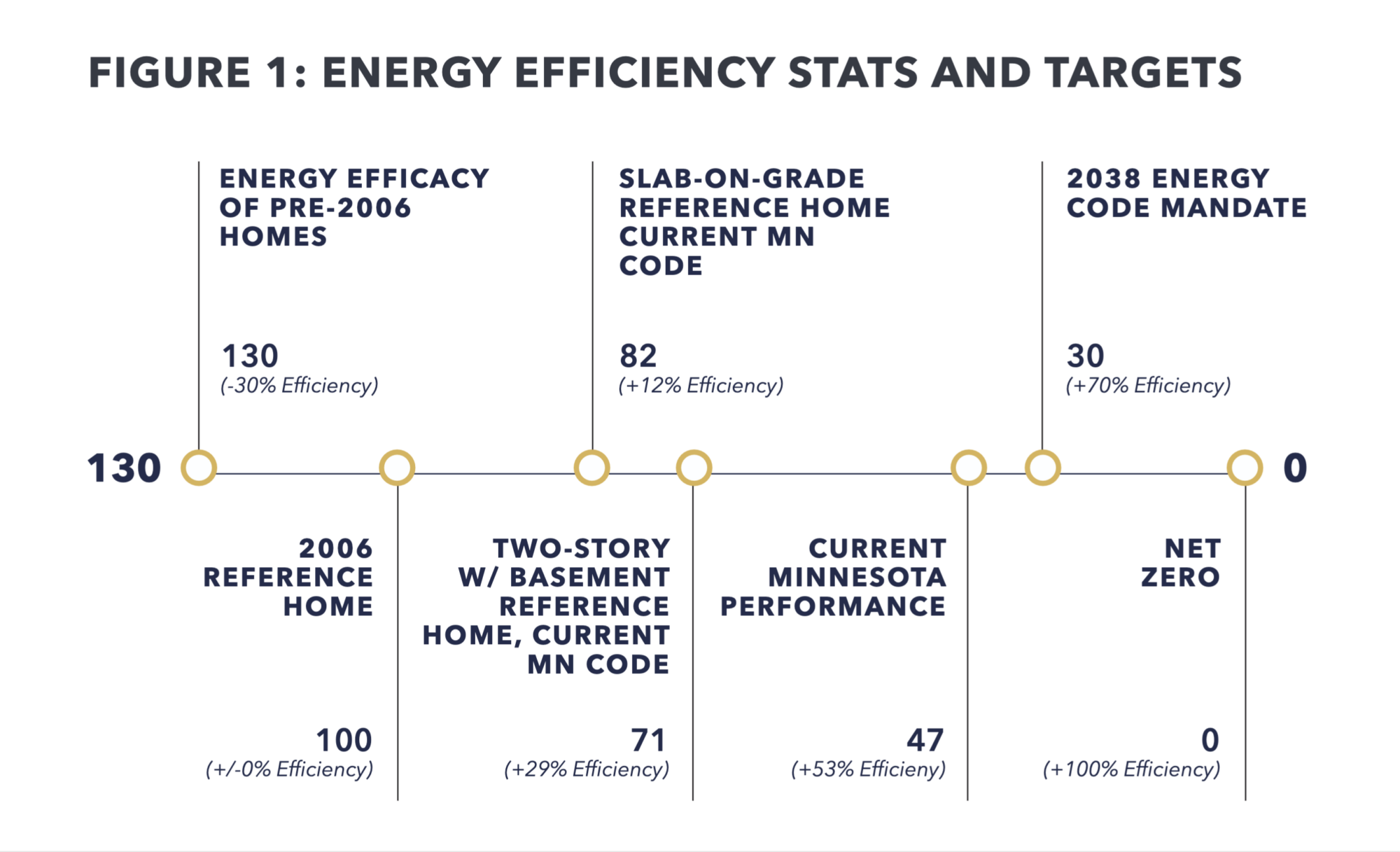
Since most tested new homes in Minnesota perform better than code minimum, there is a difference between current average performance and current code minimum.
Despite this relatively narrow gap remaining, the report wrongly claims how a strengthened code will impact construction costs without considering the savings they provide in lower energy bills.
Unfortunately, these exaggerated reports are part of a pattern. The American Council for an Energy Efficient Economy (ACEEE) recently warned that the National Association of Homebuilders (NAHB) has repeatedly used inflated cost estimates in anti-code advocacy, claiming increased costs of “as much as $31,000″ for code changes that their own research only estimated at $6,000-9,000, and which HUD estimated at $8,613. These exaggerations are unhelpful at overcoming building affordability challenges that Minnesotans face.
What does this look like in a monthly budget?
Building a home to be more energy efficient saves homeowners money by reducing the home’s energy needs. The Pacific Northwest National Library’s (PNNL) most recent Minnesota-specific estimates found that going from current code to the 2021 International Energy Conservation Code (IECC) would result in:
- An increase of $10-$16 per month on the mortgage
- A decrease of $18-$31 per month on utilities
- A nominal increase in down payment closing costs of $351-$556
- Total savings over a 30-year period of $2,539-$4,508
This is a win-win-win: homeowners save money, their home is safer and healthier, and we build a cleaner Minnesota for all.
Our next residential energy code in Minnesota will be based on the 2024 IECC. Though PNNL has not prepared a state-level analysis for this yet, the national evaluation found total incremental construction costs of $1,507 more in Climate Zone 6 and $43 less in Climate Zone 7 compared to the 2021 IECC. Annual energy cost savings from 2021 to 2024 were $191 in CZ 6 and $309 in CZ 7.
Any increase in energy costs above what PNNL predicts will also bring a return on the investment faster and larger. Minnesota can — and should — construct buildings to be more efficient to make them more affordable.
Stay tuned for Part II
Ideally, most of the homes we build today will be around for 100 years or more like mine has been. Opponents of strong energy codes have every right to ask: can we afford to do this? Fresh Energy will continue showing up to answer: yes, and here’s how. But there is another question worth asking: can we afford not to do this?
Next month, I’ll continue this series on energy affordability in Minnesota’s buildings by diving into how homes are built in the state, what actually makes housing unaffordable, supply challenges and opportunities, and how energy efficiency impacts human health and safety.
Climate change is already affecting the health, wellbeing, and finances of Minnesotans. The homes we build today will impact families for many decades — some over a century. And while I can’t go back in time to put thicker insulation in my old home, I can advocate for stronger building codes that help Minnesotans live in safer, more affordable homes. Stay tuned for Part II next month.
Interested in learning more? Tune in to our August 2026 episode of Decarbonize: The Clean Energy Podcast Fresh Energy’s Isak Kvam and Eric Fowler to explore why efficient homes are affordable homes and what role the energy code has to play.
Decarbonize is also available on your favorite podcasting platform, including Apple Podcasts, Spotify, YouTube, and more.