
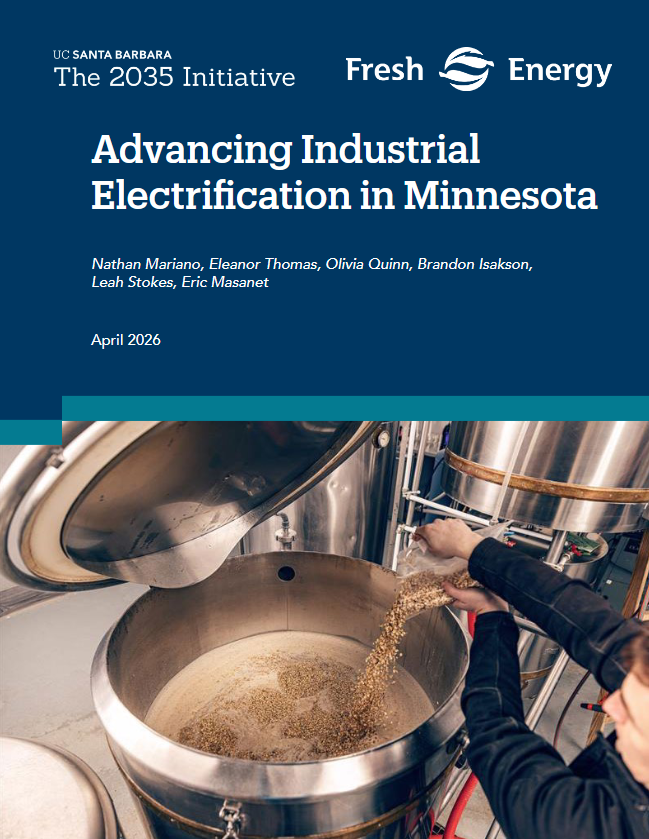
The 2035 Initiative and Fresh Energy release “Advancing Industrial Electrification in Minnesota” report and will host a webinar on May 14 for policymakers and advocates.
The 2035 Initiative at UC Santa Barbara and Fresh Energy have released “Advancing Industrial Electrification in Minnesota,” a new co-authored report that identifies how electrifying industrial heat can significantly cut greenhouse gas emissions while strengthening one of Minnesota’s most important economic sectors.
Manufacturing employs more than 300,000 Minnesotans and contributes roughly 11% of the state’s GDP each year. At the same time, the industrial sector is responsible for approximately one-fifth of Minnesota’s greenhouse gas emissions, largely from burning fossil fuels used to generate low- and medium-temperature process heat. This heat is used for everything from cooking food products, to driving chemical reactions, to sterilizing equipment. As Minnesota advances toward its goal of net-zero emissions by 2050, the report finds that industrial heat electrification represents one of the most immediately actionable and cost-effective decarbonization opportunities available.
“This research shows that industrial electrification is no longer a distant or theoretical solution,” said Dr. Eric Masanet, Professor and Mellichamp Chair of Sustainability Science for Emerging Technologies at the UC Santa Barbara. “For Minnesota, electrifying low- and medium-temperature industrial heat can deliver major emissions reductions with technologies that are already commercially available, while creating a clear roadmap for how state policy can help manufacturers overcome real-world cost and infrastructure barriers.”
The report, which can be viewed here, is designed to support elected officials, state agencies, utilities, industry leaders, and other decision-makers as they navigate the complex transition ahead.
The report’s analysis builds on The 2035 Initiative’s nationally focused roadmap, “The Clean Heat Climate Opportunity,” and applies those learnings directly to Minnesota’s manufacturing facilities, zeroing in on the chemicals, food and beverage, and pulp and paper sectors. The study finds that with ongoing grid decarbonization, strategic electrification of industrial process heat could reduce cumulative emissions at major facilities by as much as 66 percent between now and 2050. Beyond climate benefits, the report underscores that modernizing industrial heat systems can improve energy efficiency, reduce harmful air pollution, and help ensure Minnesota-made goods remain competitive in an increasingly carbon-constrained global economy.
“Industrial emissions are some of the hardest to mitigate, but Minnesota is well-positioned to take on the challenge,” said Dr. Leah Stokes, climate policy expert and Associate Professor at UC Santa Barbara. “Our research examines the manufacturing sector where proven clean heat technologies can eliminate over 60 million metric tons of climate pollution. Paired with Minnesota’s 100% clean electricity standard, getting clean heat technologies into more manufacturing facilities represents a real climate opportunity — roughly equivalent to taking over 14 million gas vehicles off the road. Policy can help make it happen.”
The report emphasizes that strategic policy support can accelerate electrification. Reducing up-front capital and electricity price barriers is critical. In addition, smart regulations, expanded technical assistance, and workforce development are essential to closing the “implementation gap” that prevents many facilities from pursuing efficiency and electrification upgrades.
“Minnesota has a unique combination of a strong manufacturing base, ambitious climate goals, and practical policy expertise,” said Brandon Isakson, Managing Director, Industry at Fresh Energy. “This study reflects what we hear on the ground from manufacturers across the state: they want to modernize, they want to stay competitive, and with the right policy signals and support, industrial electrification can work for Minnesota communities and workers.”
Fresh Energy and The 2035 Initiative will host a briefing on the report on May 14, 2026, at 3 p.m. Central. Policymakers, advocates, interested Minnesotans, and members of the media are invited to join Fresh Energy and The 2035 Initiative on May 14 at 3 p.m. Central for a webinar to unpack the details of the report, review outlined policy pathways, and answer questions. The webinar will feature the report’s authors, including Dr. Leah Stokes, Dr. Eric Masanet, and Brandon Isakson, with opening remarks from Pete Wyckoff, Deputy Commissioner of Energy Resources at the Minnesota Department of Commerce and Kate Knuth, Climate Director at the Minnesota Pollution Control Agency. Learn more and register here.